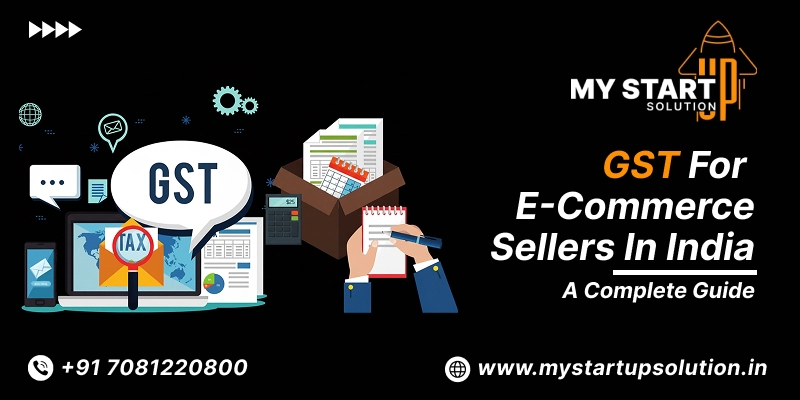
GST for E-Commerce Sellers in India
Get clear answers to the top FAQs on GST for e-commerce sellers in India. Learn about GST registration, TCS, returns, ITC, and compliance with expert guidance from My Startup Solution.
GST for E-Commerce Sellers in India: A Complete Guide by My Startup Solution
Selling online is no longer optional—it is essential. From Amazon and Flipkart to Meesho, Myntra, and your own website, e-commerce has opened doors for businesses of every size. But with opportunity comes compliance. And when it comes to online selling, GST for e-commerce sellers in India is one area you cannot afford to ignore.
I’m My Startup Solution, your friendly guide through India’s tax maze. In this blog, I’ll explain how GST applies to e-commerce sellers, who must register, how TCS under GST works, common mistakes to avoid, and how startups can stay compliant without stress.
What Is GST and Why Does It Matter for E-Commerce Sellers?
Goods and Services Tax (GST) is a destination-based indirect tax levied on the supply of goods and services in India. For e-commerce sellers, GST plays a critical role because online transactions are tracked, reported, and regulated more closely than traditional offline sales.
Under GST law, e-commerce sellers are treated differently from regular businesses. Whether you sell products, services, or digital goods, GST compliance is mandatory in most cases—even if your turnover is low.
This makes GST understanding essential for:
- Online sellers on marketplaces
- D2C brands selling via websites
- Dropshipping businesses
- Cloud kitchens and service providers using platforms
Who Is Considered an E-Commerce Seller Under GST?
Under Section 2(43) of the CGST Act, an e-commerce seller is anyone who supplies goods or services through an Electronic Commerce Operator (ECO).
Examples include:
- Selling products on Amazon, Flipkart, Meesho, Myntra
- Offering services through Urban Company or Zomato
- Selling via Shopify or WooCommerce with online payments
The platform itself—like Amazon or Flipkart—is called an Electronic Commerce Operator, while you are the seller.
Is GST Registration Mandatory for E-Commerce Sellers?
Yes. In most cases, GST registration for e-commerce sellers is compulsory, regardless of turnover.
Key Rule You Must Remember
- Unlike offline businesses, e-commerce sellers cannot use the basic exemption limit of ₹20 lakh (₹40 lakh for goods in some states).
- If you sell through an e-commerce platform, GST registration is mandatory from day one.
- This rule is clearly explained in official guidance and industry analysis
Who Must Register for GST
- Sellers supplying goods via e-commerce platforms
- Service providers selling through online marketplaces
- Sellers making inter-state supplies
- Sellers liable for TCS deduction
GST Registration Process for E-Commerce Sellers
GST registration for e-commerce sellers is similar to normal registration—but with a few extra checks.
Documents Required:
|
Document Type |
Details |
|
PAN Card |
Individual / Business PAN |
|
Aadhaar |
For verification |
|
Business Address Proof |
Rent agreement or utility bill |
|
Bank Details |
Cancelled cheque or statement |
|
Photograph |
Proprietor / Partners / Directors |
Steps to Register
- Visit the GST portal
- Select “Taxpayer”
- Choose “E-commerce seller”
- Complete Aadhaar authentication
- Receive GSTIN after approval
My Startup Solution Tip: Marketplaces will not activate your seller account without a valid GSTIN.
Can E-Commerce Sellers Opt for the Composition Scheme?
This is one of the most common questions I get. The Short Answer: No (Mostly). E-commerce sellers cannot opt for the GST Composition Scheme if they sell through marketplaces like Amazon or Flipkart.
The composition scheme is available only to sellers making direct supplies, not those routed through ECOs collecting TCS. However, there is a limited exception for certain service providers selling directly, but it does not apply to marketplace sellers in most cases.
If you are unsure, always check before opting in—wrong selection can lead to penalties.
Understanding TCS Under GST for E-Commerce Sellers
Tax Collected at Source (TCS) is a key GST concept that applies only to e-commerce.
What Is TCS in GST?
TCS is a tax collected by the e-commerce operator on behalf of the government when you make a sale through their platform.
Currently:
- TCS rate: 1% (0.5% CGST + 0.5% SGST)
- Collected on the net value of taxable supplies
For example:
If you sell goods worth ₹1,00,000 in a month and returns are ₹10,000, TCS applies on ₹90,000.
Why TCS Matters
- It reflects in your GST electronic cash ledger
- It helps the government track online sales
- Mismatch in TCS data can cause GST notices
This mechanism ensures transparency in e-commerce transactions and is a core compliance requirement
How TCS Works (Example)
|
Particulars |
Amount (₹) |
|
Product price |
10,000 |
|
GST (18%) |
1,800 |
|
Total order value |
11,800 |
|
TCS deducted (1%) |
100 |
|
Amount credited to seller |
11,700 |
The ₹100 TCS:
- Appears in your GST portal
- Can be claimed as credit
- Must be matched with GSTR filings
GST Returns Applicable to E-Commerce Sellers
GST compliance is not just about registration. Filing returns correctly and on time is equally important.
Key GST Returns You Must File
1. GSTR-1
- Monthly or quarterly
- Details of outward supplies
- Invoice-wise reporting required
2. GSTR-3B
- Monthly summary return
- Tax payment happens here
3. GSTR-2A / 2B
- Auto-generated purchase data
- Used to claim Input Tax Credit (ITC)
If you sell on multiple platforms, reconciliation becomes critical to avoid mismatches.
GST on Inter-State and Intra-State E-Commerce Sales
E-commerce often involves selling across India. GST treats these supplies differently.
Inter-State Sales
- IGST applies
- Mandatory GST registration
- Common for online sellers
Intra-State Sales
- CGST + SGST apply
- Based on the seller’s registered location
Platforms usually determine tax based on shipping address, so your GST setup must be accurate.
Input Tax Credit (ITC) for E-Commerce Sellers
One of the biggest benefits of GST is the Input Tax Credit.
What You Can Claim ITC On
- Packaging material
- Advertising and marketing
- Platform commissions
- Logistics and warehousing
- Software and professional services
Conditions to Claim ITC
- Supplier must be GST registered
- The invoice must be valid
- Returns must be filed on time
- ITC must reflect in GSTR-2B
Smart ITC planning can significantly reduce your GST burden.
GST Rates Applicable to E-Commerce Products
GST rates depend on the type of goods or services, not the platform.
Common GST Rates
|
Category |
GST Rate |
|
Clothing (below ₹1,000) |
5% |
|
Electronics |
18% |
|
Beauty products |
18% |
|
Furniture |
18–28% |
|
Food delivery services |
5% (without ITC) |
Always verify your HSN or SAC code before listing products. Wrong HSN codes can trigger audits.
Common GST Mistakes E-Commerce Sellers Make
Let’s avoid trouble before it starts.
Frequent Errors
- Delaying GST registration
- Incorrect HSN or SAC codes
- Ignoring TCS reconciliation
- Claiming excess ITC
- Missing return deadlines
These mistakes often lead to:
- Late fees
- Interest
- GST notices
- Account suspension on marketplaces
Prevention is always cheaper than correction.
GST Compliance Checklist for E-Commerce Startups
Here’s a quick checklist you can bookmark:
- GST registration completed
- Correct business address and bank details
- Product GST rates verified
- TCS data reconciled monthly
- Returns filed on time
- ITC tracked and validated
Staying organized is half the battle won.
How My Startup Solution Can Help E-Commerce Sellers?
At My Startup Solution, we simplify GST for e-commerce sellers so you can focus on growing your business. My Startup Solution handles your GST registration, ensuring your seller accounts are activated quickly and without errors. We manage monthly GST return filing and TCS reconciliation, helping you avoid mismatches, penalties, and blocked credits. Our team also ensures you claim the right Input Tax Credit (ITC) to reduce your tax burden.
If you receive a GST notice, we take care of the response and resolution. With end-to-end GST compliance support, My Startup Solution becomes your reliable tax partner at every stage of your e-commerce journey
Final Thoughts from My Startup Solution
GST for e-commerce sellers may look complex, but it doesn’t have to be overwhelming. Once you understand the basics—registration, TCS, returns, and ITC—you are already ahead of most sellers.
The key is early compliance, accurate reporting, and regular reconciliation. With the right guidance, GST becomes a tool for growth, not a roadblock. If you’re selling online or planning to start, now is the best time to get your GST structure right. Call My Startup Solution at +917081220800,We are always here to help you stay compliant and confident.