
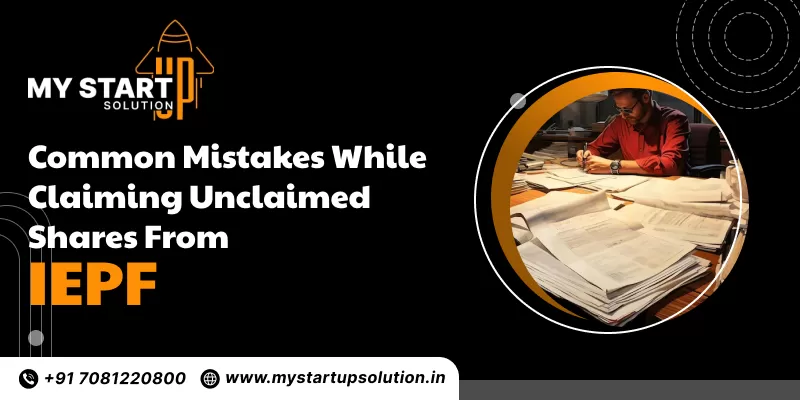
Recovering your investments that you worked so hard to make from the Investor Education and Protection Fund (IEPF) is your right however the procedure is typically full of hurdles. A lot of investors discover their claims get declined not because they are not the rightful owners but simply as a result of some minor clerical errors. The awareness of mistakes is the very first step on the path of recovery. Here at My Startup Solution, we help you through the maze of such complications plus describe the common mistakes while claiming unclaimed shares from IEPF in a neat and clean manner together with the helpful hints on how one can avoid them. The content is organized as simple and easy to understand for the Indian users.
The Investor Education and Protection Fund (IEPF) is a government initiative where unclaimed dividends and shares are transferred after 7 years of inactivity. Many investors are unaware that they can reclaim their shares through Form IEPF-5. The process involves document submission, verification, and approval by the company and IEPF authority. While the process looks simple, it requires accuracy and proper documentation. Even small mistakes can lead to rejection or delays. Due to strict verification, IEPF authorities cross-check every detail with company records and KYC documents. Therefore, applicants must be careful while filing the claim and ensure that all information is correct and complete.
Many applicants commit the same mistakes while filling IEPF Form-5. Such errors may cause the application to be rejected, delayed or require re submission.
Just a minor inconsistency between the form and the supporting documents can result in a refusal because the authority cross checks each and every detail thoroughly. Not making such mistakes is the beginning of a successful claim process.
One of the main causes for the rejection is the wrong KYC details. Information such as the name, father's name, date of birth and address should be exactly the same as the official records. Even very small spelling differences may lead to issues. The IEPF authority cross checks KYC details with company records and any discrepancy can either delay or reject the claim.
To avoid this mistake:
Accuracy in KYC is crucial for smooth processing.
PAN is a mandatory requirement in IEPF claims. Many applicants either enter the wrong PAN number or fail to verify it. If the PAN is not active or mismatched with records, the application gets rejected. In addition, the legal heirs should make sure that their PAN details are updated in the company records before they decide to register a claim.
Tips to avoid PAN errors:
Right verification of the PAN is a key to smooth and quick approval of claims.
Another common issue is mismatch between the information filled in Form IEPF-5 and the attached documents.
For example:
Such differences lead to an instant refusal as the official authority very carefully checks every single detail. Applicants are to make sure that all their documents are in perfect harmony with their form entries. One cannot emphasize enough the importance of cross checking before making the submission.
Documents play a key role in IEPF claims. Missing or incorrect attachments are one of the most common reasons for rejection.
Required documents include:
Failure to attach proper documents makes the application incomplete.
Ensure that:
Proper documentation increases the chances of approval.
Providing incorrect bank details can delay the refund process. Since the claim amount is credited directly to the bank account, accuracy is critical.
Common issues include:
Mistakes of this kind can result in denial or failure of payment.
Always ensure:
Financial validation is very crucial to ensure accuracy.
Almost all legal heirs apply directly for IEPF claims without fulfilling the transmission of shares process. If the shareholder has passed away, it is first the company's responsibility to reassign the ownership to the legal heir. This is the only way the claim will be processed. The IEPF authority does cross check the owner through the company's records. If the name remains unchanged, the claim is being turned down.
To avoid this:
This step is mandatory for legal heirs.
Affidavit and indemnity bond are legal documents required in the claim process. Many applicants make mistakes in preparing these documents.
Common issues include:
Improper legal documents lead to rejection because they do not meet compliance standards.
Ensure:
Legal accuracy is essential in IEPF claims.
Many times, candidates provide wrong information about shares, folio number or financial year.
Common errors:
Such errors result in mismatch of company records and thereby lead to rejection of the application.
Always:
Accuracy of data entry is most important.
Also Read: Financial Mistakes Every Small Business Should Avoid in 2026
To claim from IEPF, you need to act quickly and keep a track on the process. Many applicants forget to track their application status or delay submission. Delays can increase complications and processing time. Some claims require additional documents or corrections. Quicker submission and constant follow ups are key to hassle free processing.
Tips:
Being persistent is one of the ways to speed up the procedure.
Once you have submitted Form IEPF-5 online, you should forward the physical documents to the Nodal Officer of the company. A number of applicants wrongly dispatch their papers to the IEPF authority directly and this results in a delay.
Ensure:
Proper routing of documents is important for approval.
Following best practices can improve your chances of approval.
Accuracy and proper documentation are the keys to success.
Claiming shares from IEPF can be complex and time-consuming. Professional assistance can simplify the process.
My Startup Solution offers:
If you get expert guidance, you can even avoid some of the common mistakes and successfully process your claim. My Startup Solution is your partner in every step to make sure that you have a hassle free and successful IEPF claim experience. Call at +91-7081220800 for expert help.
Claiming unclaimed shares from the IEPF is a great test of your patience and accuracy. In fact, the process is laid out to be totally open but since the major part is done through paperwork it means you just cannot make a mistake here. By steering clear of these common blunders including KYC mismatches and incorrect legal document formats, you will greatly improve your likelihood of achieving a successful outcome. In fact, these shares are the fruits of your labor. Hence, it is only right to take the time to double check each detail or get expert assistance from My Startup Solution so that you can avoid wasting months on troubled paperwork.
IEPF Form-5 is usually rejected due to incorrect personal details, mismatch with company records, incomplete documentation, or errors in PAN and bank details. Even minor spelling differences can result in rejection during verification.
To avoid mistakes, carefully verify all details before submission, ensure documents match the form, update KYC records, and double-check PAN, Aadhaar, and bank details to ensure smooth and faster claim processing without rejection.
Yes, PAN is mandatory for filing an IEPF claim. It is required for identity verification and financial processing. Any mismatch or unverified PAN details can result in rejection or delay in claim approval.
Incorrect bank details can delay the refund process or cause payment failure. Always ensure that the bank account is active, linked with PAN, and matches the details submitted in Form IEPF-5.
No, legal heirs cannot directly claim shares. They must first complete the share transmission process by submitting legal documents, after which they can apply for the IEPF claim as the rightful owner.
Key documents include PAN card, Aadhaar, share certificate, bank details, Form IEPF-5 acknowledgment, indemnity bond, affidavit, and canceled cheque. Additional documents may be required depending on the nature of the claim.
KYC ensures proper identity verification. Any mismatch between KYC records and company data can lead to rejection. Updated and accurate KYC details help in faster processing and approval of IEPF claims.
Form IEPF-5 is an online application form available on the MCA portal used to claim unclaimed dividends and shares transferred to the Investor Education and Protection Fund (IEPF) by companies.
The IEPF claim process usually takes 2 to 6 months, depending on document accuracy, company verification, and authority processing time. Errors or missing documents can significantly increase the overall timeline.
Yes, if errors are found after submission, you may need to file a revised application with correct details and resubmit documents. Proper verification before filing helps avoid the need for corrections.
An indemnity bond is a legal document submitted by the claimant to protect the company against future disputes related to ownership of shares, ensuring the claim is made in good faith.
You can track your IEPF claim status online using the SRN (Service Request Number) generated after filing Form IEPF-5 on the MCA portal. It helps monitor progress and updates.
If your share certificate is lost, you must first apply for a duplicate certificate from the company or registrar. Only after that, you can proceed with filing your IEPF claim.
For expert assistance, you can contact My Startup Solution at +91-7081220800 for complete support in IEPF claim filing and documentation. Taking professional help can reduce errors and improve success chances.





"Choosing 'My Startup Solution' for my startup's accounting needs was one of the best decisions I made. The team's dedication to accuracy and their personalized approach to my financial situation set them apart. They go above and beyond to ensure I'm well-informed and compliant, allowing me to focus on my business's growth."

"The team at 'My Startup Solution' has been a true partner in my entrepreneurial journey. Their insightful financial guidance and meticulous attention to detail have helped me navigate complex financial matters seamlessly. With their support, I can confidently steer my startup toward success, knowing that my financial matters are in capable hands."