The tax regulations for businesses in India become complex when they need to employ foreign experts or Non-Resident Indians (NRIs) who work for them. The Reverse Charge Mechanism (RCM) stands as the crucial concept which you must learn to master.
MyStartup Solution provides assistance to entrepreneurs by converting complicated legal matters into straightforward solutions. Our team will help you understand how to handle payments to NRIs and foreign vendors if you are having difficulty with this process. We provide support to your startup for maintaining compliance while eliminating your worries about facing severe penalties.
In a normal business transaction within India, the person selling the service collects GST from the buyer and pays it to the government. This is called "Forward Charge." However, when you buy a service from an NRI or a person based outside India, the government cannot easily collect tax from them.
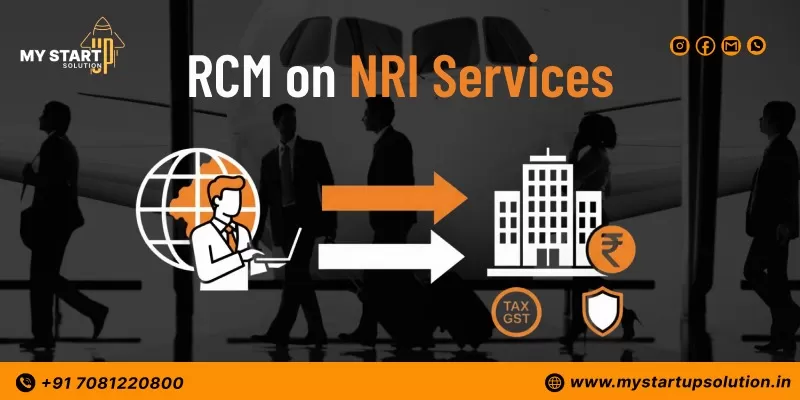
To solve this, the law shifts the responsibility. Under the Reverse Charge Mechanism (RCM), the person receiving the service must calculate the tax, pay it directly to the government and file the necessary paperwork. In simple terms you act as both the buyer and the tax collector for that specific transaction.
For a transaction to fall under RCM as an "Import of Service," three main conditions must be met:
Startups frequently use three different methods which include hiring NRI consultants for technical support, purchasing international software-as-a-service (SaaS) solutions and engaging foreign marketing agencies. The RCM rules apply to all business services which you receive from NRI consultants whether they are your friends or relatives.
Handling RCM is not just about paying the money, it involves a specific process that must be followed to avoid legal hiccups. Here is how we help you manage it:
1. Mandatory GST Registration- Unlike regular businesses that only need GST registration after hitting a certain turnover (like 20 or 40 Lakhs), RCM has no such limit. If you are liable to pay tax under RCM, you must register for GST, even if your total income is zero. Our experts at My Startup Solution can get your registration done quickly so you can start your international collaborations legally.
2. Issuing a Self-Invoice- Since the NRI provider won't give you a GST invoice, the law requires you to create one yourself. This is called Self-Invoicing. You must document the value of the service, the rate of tax (usually 18% IGST) and the details of the provider.
3. Paying the Tax in Cash- One tricky part of RCM is that you cannot use your existing Input Tax Credit (ITC) to pay this tax. You must pay the RCM amount to the government in cash through the electronic cash ledger.
4. Claiming Input Tax Credit (ITC)- The good news is that once you pay the RCM tax in cash, you can usually claim that entire amount back as ITC in the same month or the following month. This makes the tax "neutral" for most businesses but the process of "pay first, claim later" must be followed strictly.
Many new founders ignore these rules because they feel the payment is small or the provider is an individual NRI. However, the Department of Revenue tracks foreign outward remittances. If you send money abroad for Consultancy or Professional Services without paying the RCM you might receive a notice months or years later along with heavy interest and penalties.
Another common confusion is between GST, RCM and Income Tax TDS. The payment process for NRI requires TDS deduction under Section 195 of the Income Tax Act. The task of managing dual responsibilities for GST and Income Tax becomes an overwhelming challenge. My Startup Solution acts as an essential partner to businesses because of this requirement. Our team analyzes all aspects of your business needs to provide complete protection for your operations.
Navigating the world of NRI services requires a mix of GST knowledge, international taxation understanding and FEMA (Foreign Exchange Management Act) compliance. We pride ourselves on being a one-stop shop for Indian startups.
India is a global hub and working with NRIs or foreign experts is a great way to scale your business. Don't let the fear of "Tax RCM" stop you from hiring the best talent globally. With the right guidance, these compliance steps become a simple monthly routine rather than a headache.
The Indian government has made these rules to ensure that domestic service providers stay competitive with foreign ones. By following RCM, you are not just staying legal; you are contributing to a fair business ecosystem.
If you have recently made a payment to an NRI or planning to sign a contract with a foreign consultant, now is the time to check your tax liability. Waiting until the end of the financial year is often too late and leads to unnecessary interest costs.
You can speak directly with our consultants to get a clear roadmap for your business. We believe in "easy-to-understand" advice without the heavy jargon. Your focus should be on building your product and finding customers—let us handle the taxman.
Contact My Startup Solution:
Reverse Charge Mechanism (RCM) shifts the GST payment responsibility from the NRI service provider to the Indian recipient. When an Indian business receives services from an NRI located outside India, the NRI does not charge GST. Instead, the Indian recipient must calculate the applicable GST, pay it directly to the government through the GST portal, and report the transaction in GSTR-3B. This mechanism ensures tax collection on “import of services” even when the supplier is outside Indian jurisdiction.
Yes. GST registration is compulsory if you receive services from an NRI under RCM, even if your annual turnover is below Rs. 20 lakh or Rs. 40 lakh. The basic exemption limit does not apply to persons liable to pay tax under reverse charge. Startups, freelancers, and early-stage companies must obtain GST registration before making or accounting for such payments.
RCM applies to all professional and business services received from NRIs, including consultancy, legal services, software subscriptions (SaaS), digital marketing, SEO, technical testing, management services, and director remuneration. If the service is used for business purposes in India and the supplier is located outside India, it qualifies as an import of service and triggers RCM.
Most consultancy and professional services provided by NRIs attract 18% IGST under RCM. The tax must be paid in cash via the Electronic Cash Ledger. Existing Input Tax Credit (ITC) cannot be used to discharge this liability, even if sufficient credit is available.
Yes. The full amount of GST paid under RCM can be claimed as ITC after the tax is paid in cash. Once paid, the credit becomes available and can be used to offset future GST liabilities. Failure to pay RCM on time will result in denial of ITC until compliance is completed.
No. GST law mandates that RCM liability must be paid only in cash through the Electronic Cash Ledger. ITC cannot be used for payment. ITC can be claimed only after the cash payment is completed.
Yes. Software-as-a-Service (SaaS), cloud tools, and online platforms purchased from foreign vendors or NRIs are treated as import of services when used for business purposes in India. The Indian recipient must pay 18% IGST under RCM, even if the invoice is issued in USD or another foreign currency.
The invoice value must be converted into INR using the RBI reference exchange rate applicable on the date of invoice or payment (as per GST valuation rules). GST at 18% is then calculated on the converted INR value to determine the RCM liability.
Yes. Since NRIs cannot issue GST-compliant Indian tax invoices, the Indian recipient must generate a self-invoice under Section 31(3)(f) of the CGST Act. This document is mandatory for GST records and is essential for claiming ITC during audits.
Yes. A payment voucher must be issued at the time of payment to the NRI supplier as per Section 31(3)(g) of the CGST Act. Both self-invoice and payment voucher are compulsory documents for RCM compliance.
RCM transactions are reported in Table 3.1(d) of GSTR-3B, where the taxable value and tax amount are declared. The corresponding ITC is claimed in the “Eligible ITC” section of the same return, subject to payment of tax in cash.
RCM tax must be paid by the 20th of the following month while filing GSTR-3B. Delayed payment attracts interest at 18% per annum, and ITC cannot be claimed until the liability is fully discharged.
Yes. Sitting fees, commission, or any other remuneration paid to an NRI director for services rendered to an Indian company are subject to RCM. The company must pay 18% IGST on such payments under reverse charge.
You can directly call My Startup Solution at +91-7081220800. Our experts provide end-to-end assistance with GST registration, self-invoicing, and tax calculations to ensure your startup remains 100% compliant with Indian tax laws.
Non-payment or incorrect reporting of RCM leads to interest, penalties, denial of ITC, and potential GST audit notices. If detected during departmental scrutiny, businesses may face heavy fines and prolonged litigation. Timely and accurate compliance is critical.





"Choosing 'My Startup Solution' for my startup's accounting needs was one of the best decisions I made. The team's dedication to accuracy and their personalized approach to my financial situation set them apart. They go above and beyond to ensure I'm well-informed and compliant, allowing me to focus on my business's growth."

"The team at 'My Startup Solution' has been a true partner in my entrepreneurial journey. Their insightful financial guidance and meticulous attention to detail have helped me navigate complex financial matters seamlessly. With their support, I can confidently steer my startup toward success, knowing that my financial matters are in capable hands."