Subsidies Available for Food Processing Industries
Explore government subsidies available for food processing industries. Get expert help from My Startup Solution to maximize your grants. Call +91-7081220800
Subsidies Available for Food Processing Industries – Grow Your Business with My Startup Solution
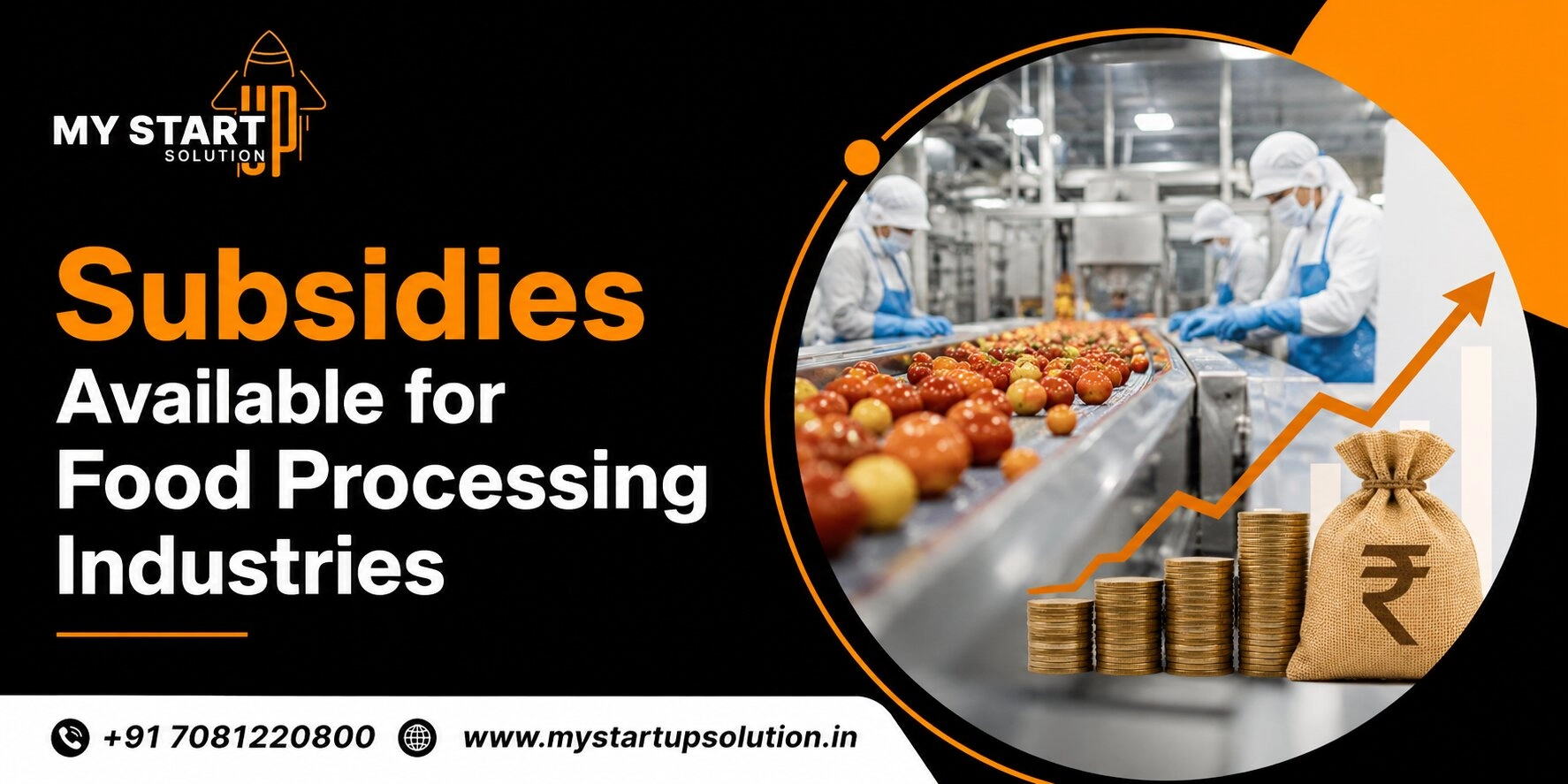
Food processing industries have become one of the rapidly developing areas of India. They create job opportunities, minimize wastage of food items, add to the earning capacity of farmers, and enable exports. Both the central and state governments provide different kinds of financial assistance schemes to set up new ventures or expand the existing ones. Subsidies available for food processing Industries can enable entrepreneurs to save money on their projects, purchase new equipment, develop infrastructure, and enhance the production capacity. My Startup Solution can assist your business in finding the appropriate subsidies and applying for them.
Why Subsidies Are Important for Food Processing Industries?
The food processing industry entails the need for land, construction of processing plants, machinery, cold storage facilities, packaging machines, transportation means, and quality control systems. This can be expensive for new entrants and MSMEs in the market. Government subsidies will lower this cost, thus encouraging them to invest in modernized processing plants. The financial aid will assist them to increase production standards, employ advanced technology and compete in the national and international markets. When planned effectively and professionally, the food processing firms will benefit from the various government facilities offered within the law.
Government Support for Food Processing Businesses
The Government of India has come up with various subsidy schemes for supporting the growth of the food processing industry in India. The objectives of these schemes include enhancing the preservation of food products, minimizing post-harvest losses, increasing exports, and boosting the rural economy. The schemes provide financial aid to entrepreneurs, MSMEs, farmer producer organizations, cooperative societies, private firms, and existing food processing units seeking expansion. Such financial assistance could be in the form of capital subsidy, interest subsidy, infrastructure subsidy, technology upgrade subsidy, quality certification subsidy and cold chain development subsidy.
Major Subsidies Available for Food Processing Industries
There are various governmental schemes available which provide monetary support to food processing companies. The most commonly opted subsidy schemes include:
- Pradhan Mantri Kisan SAMPADA Yojana
- PM Formalisation of Micro Food Processing Enterprises (PMFME) Scheme
- Cold Chain Development Scheme
- Mega Food Park Scheme
- Integrated Cold Chain and Value Addition Infrastructure
- Agriculture Infrastructure Fund
- Credit Linked Capital Subsidy Schemes
- State Government Food Processing Subsidies
- MSME Financial Assistance Programs
- Export Promotion Schemes for Food Products
Each of these schemes has its own criteria for eligibility, subsidy ceiling, and process of applying for the subsidy scheme.
Government of India: Key Subsidies for Agriculture and Food Processing
Financial assistance schemes by the Ministry of Food Processing Industries (MoFPI) aim at boosting the performance of agriculture and the food processing industry. The following table represents some of the major schemes that are in existence.
1. Cold Chain Infrastructure Development
Such a system helps in establishing a cost-effective cold chain system in order to minimize waste of produce after harvesting. It includes facilities such as cold storages, CA storage, packing houses, refrigerated transportation and processing facilities.
|
Component |
Financial Assistance |
Notes |
|
General Areas |
35% of eligible project cost |
Standard incentive for cold chain infrastructure |
|
Hilly / NE / Difficult Areas |
50% of eligible project cost |
Enhanced support for logistics challenges |
|
Maximum CFA |
Up to ₹10 crore |
Subject to MoFPI approval |
2. Creation/Expansion of Food Processing & Preservation Capacities (CEFPPC)
The scheme facilitates setting up of new processing units or upgrading the processing facilities through financial assistance for the investment on plants and machinery.
|
Category |
Subsidy Level |
CFA Ceiling |
|
General Areas |
35% of eligible plant & machinery |
Up to ₹5 crore |
|
NE / Himalayan States |
50% |
Higher support tier |
|
Difficult Tribal Areas |
50% |
Special status category |
Consultant Tip: Preparing a professional Detailed Project Report (DPR) increases the possibility of getting a subsidy.
3. Agro-Processing Cluster Scheme
Under the Agro-Processing Cluster Scheme, efforts are made for infrastructure creation that would serve more than one food processing unit. It includes a warehouse, drying facility, refrigeration, freezing, and secondary processing facility.
|
Component |
Subsidy |
|
Common Infrastructure (General) |
35% |
|
Common Infrastructure (Difficult Areas) |
50% |
|
Maximum CFA per Cluster |
₹10 crore |
Eligibility Requirement: The project must have a SPV (Special Purpose Vehicle) registered, land availability, and a feasible project proposal.
4. PMFME Credit-Linked Subsidy
The Pradhan Mantri Formalisation of Micro Food Processing Enterprises Scheme (PMFME) provides financial assistance to micro food processing enterprises, self-help groups, farmer producer organizations and cooperative societies.
|
Feature |
Assistance Details |
|
Subsidy Type |
35% credit-linked subsidy |
|
Maximum Cap |
₹10 lakh per unit |
|
Additional Support |
Branding, packaging, and skill training |
Eligibility Criteria: Applicants must be registered as Udyam Registered, possess bank loan approval and develop a comprehensive project proposal.
5. Food Testing Laboratory Subsidy
For making the food quality safe and better, there is financial support from the government for the establishment and development of food-testing laboratories.
|
Component |
Financial Assistance |
|
Equipment & Machinery |
50%–70% subsidy |
|
Maximum CFA |
Up to ₹10 crore |
Priority areas: NABL accredited labs, testing equipment and facilities for conformity with FSSAI standards.
Eligibility Criteria for Food Processing Industry Subsidies
Each government subsidy program has its own criteria for qualification. It is essential for businesses to evaluate their qualifications prior to applying. The qualification will depend on the nature of the business, size of the project, investment level, geographic location and government program chosen.
Common eligibility requirements include:
- Indian citizen or registered business entity
- New or existing food processing unit
- Valid business registration
- PAN and Aadhaar details
- GST registration, where applicable
- Project report with financial details
- Bank account in the business name
- Compliance with food safety and environmental regulations
The compliance with all the eligibility criteria enhances the likelihood of quick approval and successful processing of the subsidy application.
Documents Required for Food Processing Subsidy
Proper documentation is one of the critical elements in the subsidy application process. Errors in documentation could result in delays and even rejections of applications.
Generally required documents include:
- Aadhaar Card and PAN Card
- Business registration certificate
- Udyam Registration Certificate
- GST Registration Certificate
- Detailed Project Report (DPR)
- Land ownership or lease documents
- Machinery quotations
- Bank statements
- Net worth certificate
- Financial projections
- Partnership deed or company incorporation documents
- FSSAI Licence
- Pollution and other statutory approvals, if required
Updating all paperwork makes it possible for authorities to handle the application without any problems.
Application Process for Food Processing Industry Subsidies
A proper application for subsidy needs good planning and implementation. The right procedure will prevent mistakes and increase the probability of an approval.
The general application process includes:
- Check for eligibility criteria.
- Make the Detailed Project Report ready.
- Prepare the Detailed Project Report.
- Arrange all required documents.
- Submit the subsidy application.
- Verification by the concerned department.
- Site inspection, if required.
- Approval of the project.
- Project implementation.
- Submission of utilization documents.
- Subsidy amount released upon successful verification.
With the assistance of professionals, the whole thing can be made easier and more manageable.
Benefits of Subsidies for Food Processing Industries
There are many benefits associated with government grants for food processing firms. They help in fast growth and reduce investment risks for firms.
Major benefits include:
- Lower project cost
- Reduced financial burden
- Easier business expansion
- Better production capacity
- Modern technology adoption
- Improved product quality
- Higher profitability
- Increased employment opportunities
- Better export potential
- Reduced food wastage
- Stronger market competitiveness
- Support for rural development
These benefits enable firms to be more profitable and sustainable.
Common Mistakes to Avoid While Applying for Subsidies
Most of the subsidy applications get delayed due to some unavoidable errors. However, with proper planning and professional help, it is easy to prevent these kinds of problems.
Some common mistakes include:
- Wrong choice of subsidies scheme
- Submission of incomplete documentation
- Preparation of incorrect project report
- Incorrect financial projections
- Failure to observe deadlines
- Failure to adhere to eligibility requirements
- Inadequate record-keeping practices
- Non-adherence to government guidelines
- Delays in implementing the project
- Non-compliance with necessary approvals
These mistakes can be prevented not only to save time and money but also increase the possibility of success.
Why Choose My Startup Solution for Food Processing Subsidy Assistance?
Getting a subsidy from the government needs proper planning, technical know-how, and prompt action. At My Startup Solution, we provide all the consultancy services to help businessmen, startups, MSMEs, and existing companies who want to establish their food processing ventures. The organization helps clients right from the beginning till they acquire the subsidy. Our consultancy services cover preparing project reports, recognizing subsidy schemes, verifying documents, filing applications, compliance, departmental coordination, and much more. Through our professional consultancy services, you can concentrate on manufacturing activities, and we shall take care of other activities concerning subsidies. For expert advice on food processing subsidies, projects, and government scheme consultation, please contact us at +91-7081220800.
Conclusion
There are good business opportunities in the field of food processing in India, and the government subsidy programs further add value to such business opportunities. Financial support enables the entrepreneur to reduce the cost of a project, buy advanced equipment, build infrastructure, enhance product quality and increase production capability. Irrespective of whether it is a new project of food processing or a revival of an old project, choosing the appropriate subsidy scheme may help in the success of the project in terms of its financial aspects. My Startup Solution provides comprehensive assistance in applying for subsidies for food processing projects, from preparing project reports to filing of subsidy applications.