TDS on Consultancy Fees Paid to Foreigners NRIs
Confused about TDS rates on foreign consultancy fees? Explore our guide on NRIs’ tax rates, DTAA exemptions and compliance steps. Contact MyStartup Solution at +91-7081220800.
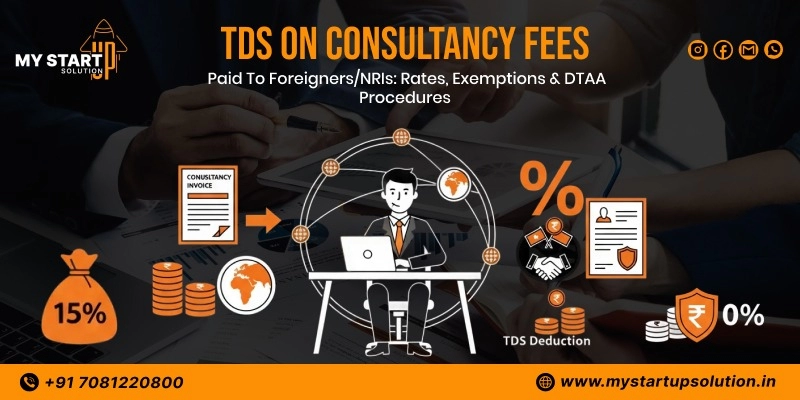
TDS on Consultancy Fees Paid to Foreigners/NRIs: Rates, Exemptions & DTAA Procedures
When a startup in India or even a big company decides to get a foreign consultant or a Non Resident Indian (NRI) for some expert advice, the payment procedure is not as straightforward as a regular bank transfer. According to the Indian Income Tax Act, it is mandatory for you to deduct tax at source (TDS) before the funds are sent abroad.
Understanding these rules is very important as failure in following them could result in the tax department issuing heavy penalties and legal notices. At My Startup Solution, we assist businesses in managing these complicated international tax matters and we tell you in detail about TDS on consultancy fees paid to foreigners/NRIs with Rates, exemptions & DTAA procedures.
Why is TDS Deducted on Foreign Payments?
The Indian government wants to ensure that any income earned from an Indian source is taxed in India. Since it is difficult to collect tax from a person living abroad once they receive their payment, the law shifts the responsibility to the payer.
If you are hiring a consultant from the USA, UK, or any other country, you act as a tax collector for the government. You must deduct a specific percentage, deposit it with the Income Tax Department, and then pay the remaining balance to the consultant. Failure to do so means you might have to pay the tax out of your own pocket.
Key Sections for TDS on Consultancy Fees
There are two primary sections under the Income Tax Act that govern these payments:
- Section 195: This is the umbrella section for payments made to non-residents. It covers any "sum chargeable to tax" under Indian law.
- Section 194J: Although this is the case most of the time for domestic payments (10%), for non residents, Section 195 usually has the priority to determine the appropriate rate based on the type of service.
Applicable TDS Rates for FY 2025-26
The rate of TDS depends on whether the consultant is an individual or a foreign company. Generally, the rates are as follows:
- Fees for Technical Services (FTS): Normally the rate is in the range of 10% to 20% (plus the applicable Surcharge and Health & Education Cess).
- Without PAN: If the foreign consultant is unable to provide a PAN or Form 13, then as per Section 206AA, the TDS rate could be escalated to a flat 20% or even higher.
- With DTAA: If the consultant's country has a treaty with India, the rate might be reduced (usually 10%).
The Role of DTAA (Double Taxation Avoidance Agreement)
DTAA is a way to provide relief. It makes sure that a consultant is not taxed for the same income both in India and their home country.
- Lower Tax Rates: Many treaties limit the tax rate on consultancy fees to 10%.
- The "Make Available" Clause: In some treaties (like India-USA), TDS is only applicable if the consultant "makes available" technical knowledge to the Indian company, allowing them to perform the task independently in the future.
- Tax Residency Certificate (TRC): To claim DTAA benefits, the foreigner must provide a TRC from their home government.
Essential Documents Required for Foreign Payment
To remain compliant and avoid a 20% flat tax, you will have to obtain the following details from the foreign consultant:
- Tax Residency Certificate (TRC): The government of their country issues this certificate.
- Form 10F: It is a declaration form made by the individual himself/herself when the TRC does not have all the necessary details.
- No PE Declaration: A kind of confirmation letter that the individual or organization does not have a "Permanent Establishment" (office) in India.
- PAN or Alternative Documents: Passport copy or tax ID from their country.
Procedure to Pay TDS and File Returns
Following the correct workflow is essential to avoid the "Assessee in Default" status.
- Calculate the Gross-Up: If the contract says "Net of Taxes," you must calculate the gross amount so the consultant gets the full agreed amount after tax.
- Get Form 15CB: It is basically a Chartered Accountant's certificate that confirms the proper calculation of tax.
- Send Form 15CA: This is an internet declaration made by the remitter (company) on the Income Tax portal.
- Pay Tax: Use Challan 281 for the payment of tax within 7 days from the next month.
- Quarterly Returns: File Form 27Q every quarter to report all foreign payments.
Mandatory Compliance: Form 15CA and 15CB
Before you can send money abroad through your bank, you must complete a digital "clearance" process.
- Form 15CA: It is a declaration made online by the remitter (you) at the Income Tax portal. It mainly contains details of the payment and the tax deducted.
- Form 15CB: It is a credential provided by a Chartered Accountant. The CA confirms that you have computed the TDS correctly and adhered to all DTAA provisions.
Note: Usually, Form 15CB is mandatory if the payment is over 5 Lakhs in a financial year and is taxable in India.
Also Read: Managing Litigation in India While Living Abroad
Common Exemptions and Reliefs
Not every payment to a foreigner results in TDS. There are cases where you can be exempt from TDS, for example:
- The services are performed entirely outside India and have no "territorial nexus" with India (though this is a grey area and needs CA certification).
- The payment is for personal use (rare for consultancy).
- The income is not taxable in India under specific DTAA provisions.
Consequences of Non-Compliance
Ignoring the rules related to TDS can result in:
- Disallowance of Expense: Income Tax authorities will disallow the deduction of the consultancy fees as business expenses which will result in an increase in your tax liability.
- Interest: 1% to 1.5% interest per month on the delayed deduction or payment.
- Penalty: Penalties equal to the amount of tax not deducted.
Why Choose My Startup Solution for Compliance?
Tax laws get changed all the time. My Startup Solution is going to ensure that your business is fully compliant with the latest updates of the Finance Act. We help you in:
- Accurate TDS for Foreign Vendors: Expert calculations that consider the application of DTAA rates and withholding requirements thus completely removing the risk of overpayment and penalty.
- Drafting Net of Tax Contracts: Skillful legal drafting which guarantees that your vendor payments are clear, well protected and tax efficient for all parties involved.
- Instant 15CA & 15CB Certificates: Intuitive auto generation of documents backed by a professional attestation that enables your foreign remittances through the least possible paperwork and delays.
- Error Free 27Q Returns: Efficient submission of quarterly statements for non resident payments, with absolutely correct results and no compliance issues.
If you want smooth and mistake free international tax handling, do not hesitate to get in touch with MyStartup Solution at +91 7081220800. We make it easy for Indian entrepreneurs to do business globally.
Conclusion
Handling TDS on consultancy fees paid to foreigners is a matter of balance between Indian domestic laws and international treaties. Although the default rate under Section 195 can be high, it can be considerably lowered by means of a Tax Residency Certificate and the Double Taxation Avoidance Agreement (DTAA) benefits. It goes without saying that you should always have Form 15CA and 15CB ready before you make the remittance to comply with the law.