

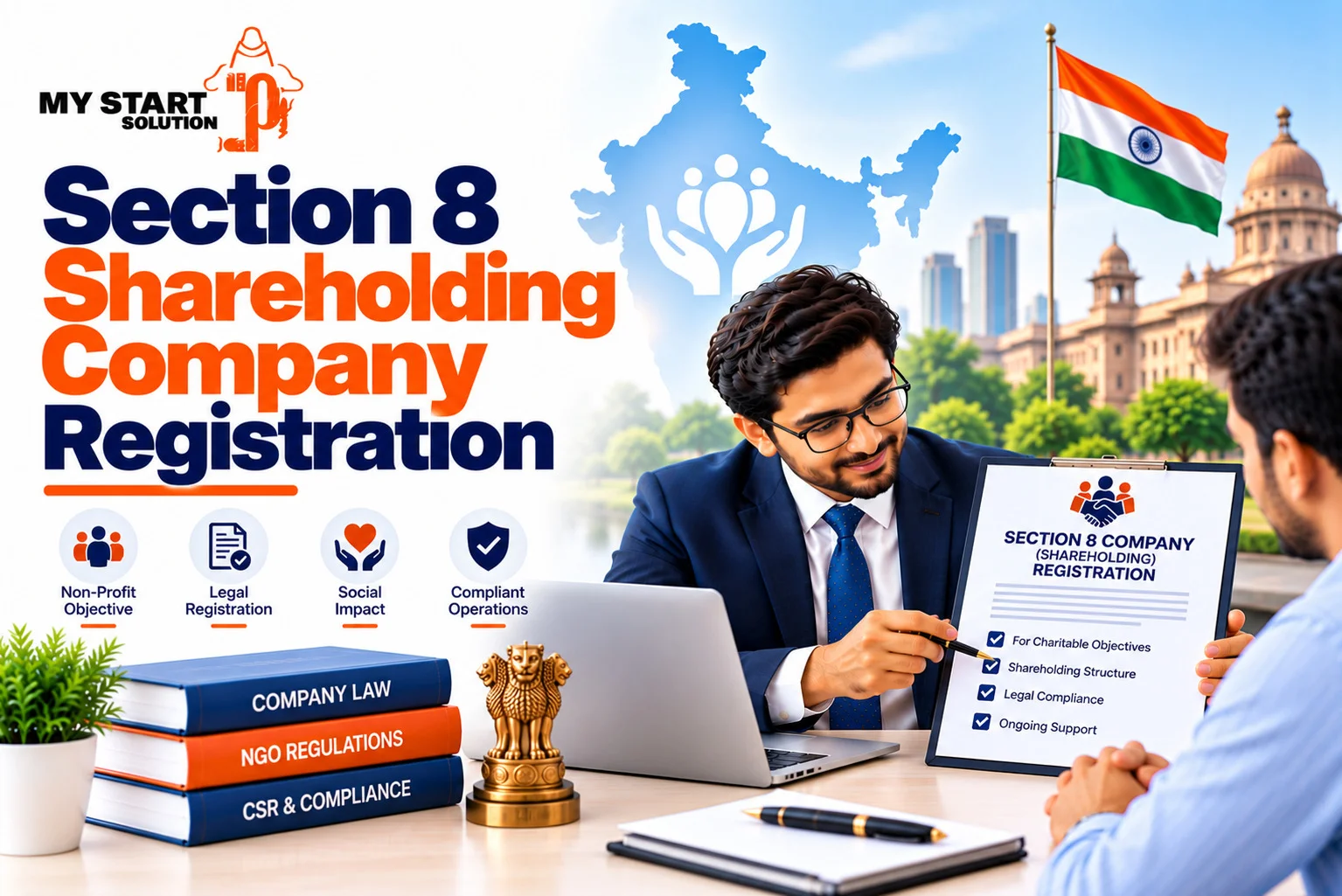
Section 8 Shareholding Company Registration
Section 8 shareholding company registration is suitable for individuals and organisations planning to establish a non-profit company for charitable, social, educational, religious, environmental or other permitted objectives. Professional assistance can help with documentation, incorporation forms, MOA and AOA preparation, and MCA filing requirements.
Whats Included
- ✓ Section 8 company structure and document review
- ✓ MOA and AOA preparation assistance
- ✓ MOA and AOA preparation assistance
- ✓ Guidance on subscriber, director and registered-office documentation
Get Free Expert Consultation
Section 8 Shareholding Company Registration
Section 8 shareholding company registration is suitable when the proposed organisat...
A Section 8 company is a company incorporated under the Companies Act, 2013, for promoting charitable or socially beneficial objectives such as education, social welfare, environmental protection, research, sports, art, culture, and other permitted activities. Unlike an ordinary commercial company, its income and profits are applied towards its stated objectives rather than distributed to members as dividends.
Section 8 shareholding company registration is suitable when the proposed organisation wants to operate through a corporate structure while pursuing non-profit objectives. The company may be incorporated with share capital, subject to the applicable legal requirements and the structure selected by the promoters.
My Startup Solution can assist with the incorporation process, documentation, and applicable MCA filings based on the proposed objectives and structure of the organisation.
What Is a Section 8 Shareholding Company?
A Section 8 company is a company formed for charitable or other specified social objectives. Section 8 of the Companies Act, 2013 governs such companies. A Section 8 company may be incorporated with or without share capital. Where the proposed structure includes share capital, the members subscribe to shares according to the incorporation documents. However, the company's income and property must be applied towards its stated objects, subject to the applicable provisions of the Companies Act and its constitutional documents. The proposed name, objects, MOA, AOA, subscribers, directors and registered office details must be appropriately prepared before filing the incorporation application.
Who Can Choose Section 8 Company Registration?
This structure may be considered by promoters who want to establish a formal organisation for activities such as:
- Education and skill development
- Social welfare and community development
- Environmental protection and sustainability
- Promotion of art, culture and heritage
- Sports and related activities
- Research and development
- Charitable and philanthropic activities
- Other permitted objects covered under Section 8
The suitability of the structure depends on the proposed activities and applicable legal requirements.
Key Features of a Section 8 Shareholding Company
A Section 8 company has specific characteristics that distinguish it from an ordinary profit-oriented company.
Non-Profit Objective
The company's objects must relate to activities permitted under Section 8. Any income generated is intended to support the company's stated objectives.
Share Capital Structure
A Section 8 company can be incorporated with share capital. The shareholding and subscription details need to be properly reflected in the incorporation documents.
Separate Legal Entity
Once incorporated, the company has a separate legal identity from its members. It can own property, enter into contracts and undertake activities in its own name, subject to applicable law.
Regulated Corporate Structure
The company operates under the Companies Act, 2013 and is subject to applicable corporate compliance and reporting requirements.
Restrictions on Distribution of Profits
The company's income and profits cannot simply be distributed among members as dividends. They are required to be applied towards the company's permitted objectives, subject to the applicable legal framework.
Documents Required for Section 8 Company Registration
The exact documents can vary depending on the proposed structure, subscribers, directors and registered office. Common incorporation documents may include:
- PAN and identity proof of subscribers and proposed directors
- Address proof of subscribers and directors
- Residential address details
- Passport-size photographs, where applicable
- Proposed company names
- Details of the proposed Section 8 objects
- Registered office address proof
- Utility bill of the registered office
- No-objection certificate from the premises owner, where applicable
- Memorandum of Association (MOA)
- Articles of Association (AOA)
- Digital Signature Certificates (DSCs) and other applicable details
The Ministry of Corporate Affairs specifically lists documents and declarations required for Section 8 incorporation, including subscriber identity/address documents and registered-office-related documents.
Process for Section 8 Shareholding Company Registration
1. Discuss the Proposed Objects
The first step is to understand the organisation's proposed activities and determine whether they are appropriate for a Section 8 structure.
2. Select the Company Name
A suitable name is proposed according to the nature of the organisation and applicable MCA naming requirements. The proposed name should be checked for availability and compliance with applicable rules.
3. Prepare Incorporation Documents
The required details and documents are collected from the subscribers and proposed directors. The MOA and AOA are prepared according to the proposed structure and objects.
4. Prepare and File MCA Forms
The incorporation application is filed through the applicable MCA incorporation process. MCA's current incorporation framework uses SPICe+ and linked forms, with specific requirements applicable to Section 8 companies. The e-MOA form INC-13 is used for Section 8/Part I Section 8 companies in applicable incorporation filings.
5. MCA Review and Clarifications
The submitted application is examined by the relevant authorities. If clarification or resubmission is required, the application may need to be appropriately responded to within the applicable process.
6. Incorporation
After the applicable requirements are completed and the application is approved, the company is incorporated and the relevant incorporation documents are issued.
Why Professional Assistance Can Be Useful
Section 8 incorporation involves more than simply submitting a company registration application. The company's proposed objects, name, constitutional documents, subscriber details and registered office documentation need to be coordinated correctly.
Professional assistance can help with:
- Understanding the appropriate Section 8 structure
- Reviewing proposed charitable or social objectives
- Preparing incorporation-related documents
- Coordinating subscriber and director information
- Preparing MOA and AOA
- Supporting applicable MCA form filing
- Addressing documentation issues or resubmission requirements
- Understanding post-incorporation compliance responsibilities
With My Startup Solution, the incorporation process can be organised around the specific objectives and proposed shareholding structure of the organisation.
Section 8 Company Registration With Share Capital
Promoters sometimes use the term "Section 8 shareholding company" when they intend to establish a Section 8 company with share capital and identifiable members holding shares. The proposed shareholding, subscription details and constitutional documents should be structured consistently with the applicable provisions. A professional should review the proposed arrangement before filing, particularly where there are multiple subscribers, non-individual subscribers or other special circumstances.
It is also important to distinguish a Section 8 company from a conventional private limited company. The purpose, use of income, constitutional restrictions and compliance framework can be different.
What Happens After Registration?
Incorporation is only the beginning of the company's corporate life. A registered Section 8 company may have continuing obligations under the Companies Act, applicable rules, tax laws and other regulations depending on its activities.
Depending on the organisation's circumstances, ongoing areas may include:
- Maintenance of statutory records
- Board and member-related compliances
- Accounting and financial records
- Annual filings
- Income-tax-related requirements
- Applicable audit requirements
- Regulatory registrations or permissions relevant to its activities
Additional registrations or approvals should not be assumed to be automatically included with Section 8 incorporation. Their applicability depends on the organisation's activities and intended operations.
Start Your Section 8 Company Registration
If you are planning to establish a non-profit organisation through a corporate structure, Section 8 shareholding company registration can provide a formal framework for carrying out eligible social or charitable objectives.
Before starting the application, it is useful to finalise the proposed objects, company name, subscribers, directors, shareholding structure and registered-office details. Proper preparation can make the incorporation process more organised and help reduce documentation-related issues.
My Startup Solution can assist with the applicable incorporation documentation and MCA filing process based on the proposed Section 8 company structure. For the latest filing requirements and forms, applications should be prepared according to the current MCA framework.
Eligibility Criteria for Section 8 Shareholding Company Registration
- Charitable or Non-Profit Objective: The company must be formed to promote objectives such as education, social welfare, research, environmental protection, sports, art, charity, or other permitted activities.
- Profit Distribution Restriction: Income and profits must be used towards the company’s objectives and cannot be distributed as dividends among members.
- Minimum Members: The proposed Section 8 company must meet the applicable requirements for members and directors under the Companies Act.
- Registered Office in India: The company must have a registered office address in India with the required address proof.
- Lawful Objectives: The proposed activities and objectives must comply with applicable provisions of the Companies Act and other relevant regulations.
- Regulatory Approval: Registration is subject to approval from the Ministry of Corporate Affairs and fulfilment of the prescribed incorporation requirements.
Documents required
Documents Required for Section 8 Shareholding Company Registration
Registration process
A simple four-step process, start to finish.