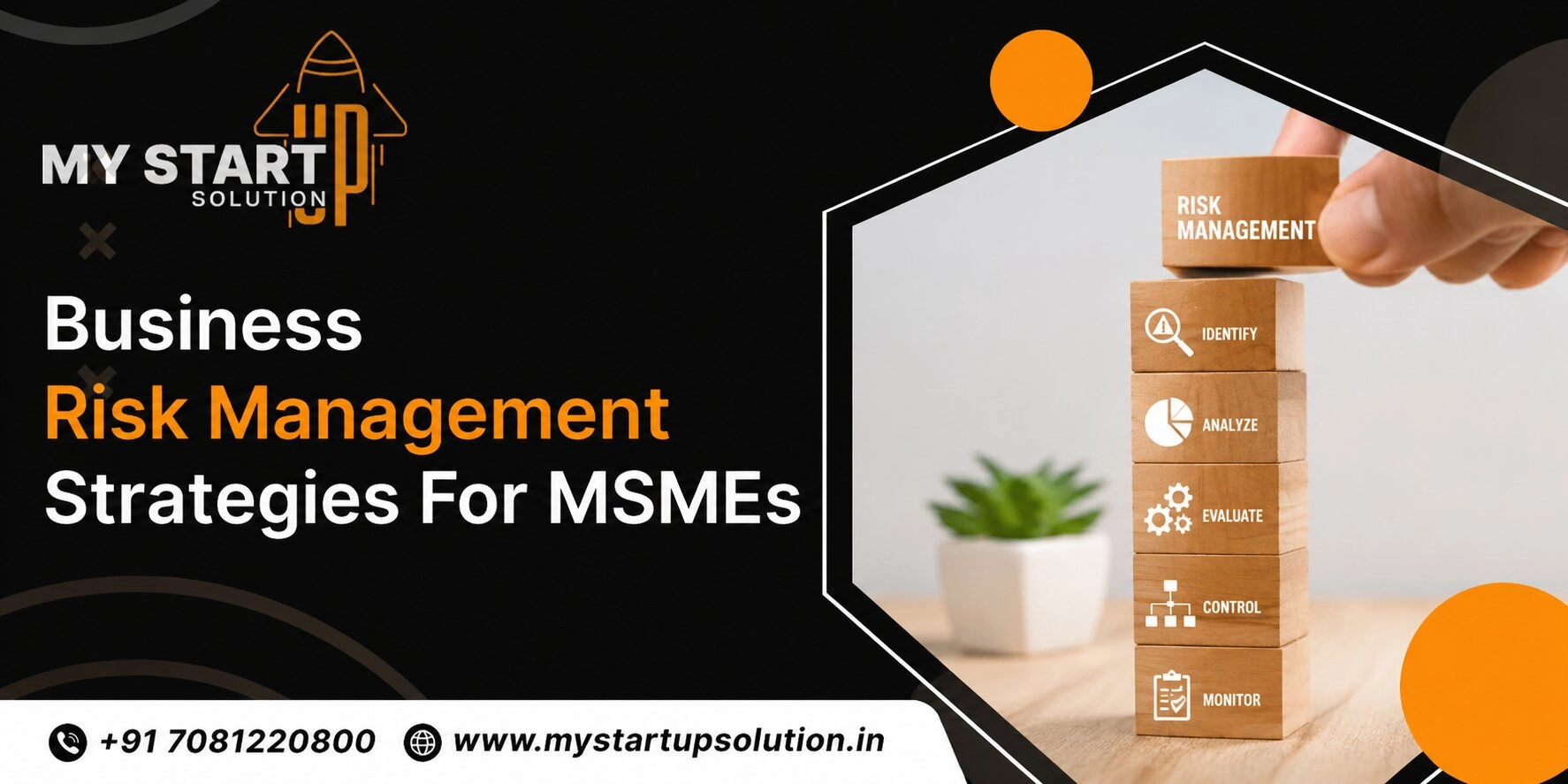
Business Risk Management Strategies for MSMEs
Protect your business with effective Business Risk Management Strategies for MSMEs. Get expert support from My Startup Solutions. Call +91-7081220800 today.
Business Risk Management Strategies for MSMEs
Micro, Small and Medium Enterprises (MSMEs) have great importance for the Indian economy. These are sources of jobs and innovations that lead to growth in industries. But at the same time, operating an MSME is not an easy task due to various difficulties faced by business owners which include competition, customers' demands, financial problems, compliance with laws, supply chain issues and many other factors.
It is true that all businesses encounter risks, but risks may be felt more deeply in case of MSMEs due to lack of sufficient resources. Risk management will help businesses to detect possible risks in advance and prevent their negative influence. Proper risk management will guarantee protection of business operations, stability and further development. Startup Solutions offers comprehensive understanding, assessment and management of business risks for MSMEs. Professional advice will allow you to develop your business without unnecessary risks.
Understanding Business Risk in MSMEs
Business risk can be defined as a circumstance that can impact the firm’s capacity to realize its objectives. Business risks can be either internal or external and they might not necessarily be under the control of the organization.
Some of the common risks facing small and medium scale enterprises (MSMEs) are:
- Financial risk
- Market risk
- Operational risk
- Compliance risk/legal risk
- Technological/ cyber risk
- Supply chain risk
- Human resource risk
- Reputation risk
Importance of Risk Management for MSMEs
Risk management involves more than just loss prevention. It also forms an important base for achieving sustainable business growth.
Good risk management will enable MSMEs to:
- Improve their decision-making processes
- Avoid unexpected losses
- Safeguard their assets
- Remain compliant with all the laws
- Increase customer trust
- Maintain their financial stability
- Make themselves resilient
- Operate efficiently
MSMEs that engage in proactive risk management are well-positioned to deal with any uncertainties in the markets.
Identify Potential Business Risks
Risk identification is one of the first things that need to be done in risk management.
Business owners must consider and monitor:
- Financial reports.
- Business processes.
- Relationships with vendors.
- Client feedback.
- Industry trends.
- Compliance requirements.
The use of a risk register will allow you to document all possible risks and their effect on business activities. Through regular risk assessment, MSMEs will be able to identify red flags and make preventive actions in advance.
Develop a Strong Financial Management System
Financial risks are some of the most common risks that face MSMEs. Inadequate financial risk management through poor cash flow management, late payments, increasing costs and poor budgeting pose major risks to MSMEs.
For a business to decrease financial risks, it should:
- Ensure proper record keeping
- Have monthly budgets
- Regularly check its cash flows
- Cut down on unnecessary spending
- Have an emergency fund
- Have diverse income streams
Having enough working capital ensures that businesses overcome tough times and keep operating despite any financial disruptions. Financial planning is an effective way of minimizing financial risks for businesses.
Diversify Customer and Revenue Sources
Being dependent on one particular customer, product or market is risky for business because in case of loss of that customer or reduction in demand, losses would be incurred by the business.
To minimize these risks, MSMEs must concentrate on the following:
- Broadening the customer base
- Penetrating new markets
- Providing other products and services
- Using e-commerce to sell their products
- Generating multiple sources of income
Strengthen Supply Chain Management
Disruptions in the supply chain may impact production processes and deliveries to customers. Businesses can reduce risks of disruptions in their supply chain through:
- Collaborations with several suppliers
- Assessing the credibility of the suppliers
- Storing buffers in stock
- Analyzing market dynamics
- Developing alternative procurement plans
Flexibility in the supply chain will help MSMEs adapt rapidly to disruptions in the case of any unforeseen circumstances. Supplier collaboration will be beneficial for business continuity.
Ensure Legal and Regulatory Compliance
Compliance failure will result in sanctions, legal complications, and negative publicity.
The MSME should remain current regarding:
- GST compliance
- Income tax compliances
- Labour law compliance
- Company law compliance
- Industry compliance
- Environmental and safety compliance
Regular compliance audits assist in detecting any loopholes and rectifying them to avoid major difficulties. Professional compliance services ensure that the company fulfills all the obligations.
Invest in Technology and Cybersecurity
The emergence of digital transformation has brought new opportunities to MSMEs but has also exposed them to cybersecurity threats. Cybersecurity breaches such as data breaches, malware attacks and system failure may interfere with business operations and result in financial loss.
The business should:
- Use secure software solutions
- Keep applications up to date
- Have proper password management
- Backup critical information
- Educate employees on cybersecurity measures
- Have antivirus protection installed
Cybersecurity is now one of the essential elements of business risk management. Technology investments bring efficiency and effectiveness.
Build a Skilled and Reliable Workforce
The employees are considered to be one of the most valued assets of any business. However, problems related to the work force may pose some difficulties in business operations.
The MSMEs should concentrate on the following factors:
- Training of employees.
- Skill development.
- Monitoring their performance.
- Ensuring workplace safety.
- Retention programs.
- Communication channels.
A trained and motivated work force ensures increased productivity and lowered operational risks.
Create a Business Continuity Plan
There may be unexpected events that would affect business operations such as disasters, economic downturns, pandemics or technical failures. A business continuity plan will help organizations react fast in case of an emergency.
The plan must have the following elements:
- Emergency action plan.
- Backup work arrangement.
- Recovery of data.
- Communication policy.
- Suppliers' contingencies.
- Financial recovery plan.
Businesses that are ready for emergencies are able to recover faster.
Monitor Risks Continuously
Risk management is a process that does not occur once. There are still changes in the business environment and it is possible for risks to be identified later on.
The MSMEs have to:
- Perform risk reviews on a regular basis.
- Monitor important business indicators.
- Assess market conditions.
- Assess financial performance.
- Update their risk management policies.
Continuous monitoring enables businesses to prepare themselves and be able to cope with any changes.
How My Startup Solutions Can Help MSMEs
The handling of business risks involves skills and knowledge that take time and experience. Many MSMEs find it difficult to manage business risks as they focus on the day to day activities and growth of their business.
My Startup Solutions offers expert assistance in managing:
- Business compliance.
- Financial planning and advisory services.
- Risk assessment.
- GST & taxation.
- Business registration.
- Corporate advisory services.
- Strategic business planning.
The team assists MSMEs to evaluate possible risks that may arise, improve internal procedures and develop a proper risk management system. MSMEs will be able to make well-informed decisions with the help of My Startup Solutions.
Conclusion
Risks are always present when conducting any type of business activity; however, careful planning can help minimize their effects to a significant extent. MSMEs that have financial discipline, compliance management, operation, technology security and business continuity planning at heart are more likely to succeed in the future.
Risk management should be considered a regular business procedure and not just an individual process. With an early identification of potential risks and proper measures taken, companies can secure themselves, ensure stability and develop further. Collaboration with professionals from My Startup Solutions will help businesses perform risk management procedures in a more convenient way. For professional support you can call us at +91-7081220800.