
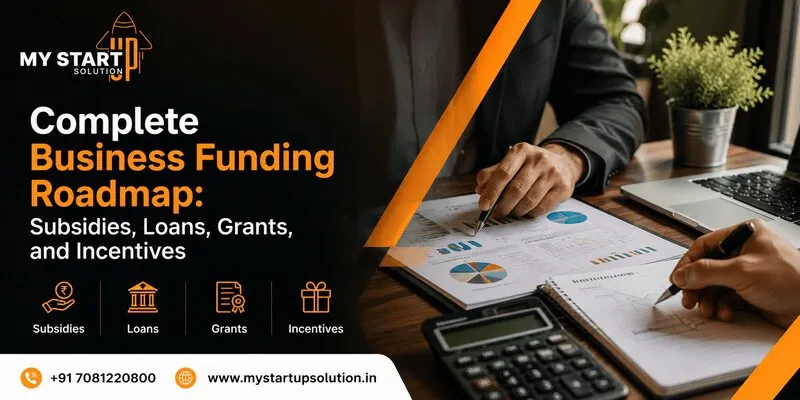
Starting a business becomes easy when there are proper financial resources available. A business firm may be a new venture, small or MSME, but each of them requires financial resources for development, purchasing, hiring staff members and improving productivity levels. The Complete Business Funding Roadmap, which covers subsidies, loans, grants, and incentives, helps entrepreneurs understand the various funding opportunities available in India. My Startup Solution gives full guidance regarding the right sources of financing according to the needs of the business firms. With proper planning and financial experts' assistance, business firms can easily succeed using the Business funding in India without making any financial errors.
Funding for businesses is the process of securing finances for starting up, operating, or expanding a business. The small business owner always requires additional funds to be used in buying equipment, employing more workers, purchasing inventory or advertising the company. Without adequate funding, the best of ideas will fail. There has been an enormous rise in the area of startup funding in India due to several programs that have been launched in recent times. With funding, you give your business the potential to grow and compete much better. Funding makes it easier for you to cope with any urgent requirement of money without having to worry about anything.
Funding is not a one time process; there is an entire process to be followed by anyone running a business. The process is quite clear and everyone who wants to get funding should follow it. A good guide will help you choose the right scheme to follow.
The above guide makes sure that your funding process is smooth throughout the entire process.
A subsidy is money provided by the government to finance a business undertaking. The subsidy is not a loan, which means that it is never required to be paid back. Government business subsidies are usually awarded to attain certain objectives such as exporting, rural uplift, or green energy. There are many state and central programs which provide subsidies to decrease the cost of establishment of the unit. The subsidies will decrease the interest rate, cut down on equipment cost or subsidize a part of the project cost. The subsidies are ideal for businesses meeting the given conditions because they decrease the burden of finance without the burden of repayment.
A loan refers to borrowed money which has to be paid back with interest. Business loans for MSMEs are provided by banks, NBFCs and government-sponsored schemes. The purpose of such loans includes working capital, machines and business expansion. Some loans require collateral, whereas some loans do not require any collateral in certain schemes. The size of the loan, rate of interest and period of repayment are decided according to your type of business and creditworthiness. Loans help in case you need money urgently and pay them back within a certain period. Loans enable you to utilize the money as per your business requirement.
The grant is money which is given for some particular project or work and like subsidy, the grant does not require any repayment. Business grants in India are normally given in areas of research and innovation, women entrepreneurship, and rural areas. Grants are generally more competitive than loans because there is limited money to be divided among many applicants. In most cases, you have to provide a project report about what you are going to do with the grant. This grant helps your business to grow without any loan, so it is very wise for you to go for the grant.
An incentive is a reward that is provided to stimulate a specific type of behavior within the firm such as providing tax benefits, reducing the amount of duty or giving more assistance to export products. Government incentives for businesses are intended to develop various sectors including manufacturing, technology, and environmental friendly energy. The incentives can take the form of tax holiday, lowering the import duty or money rewards for achieving certain goals. Often the MSME funding schemes combine the incentives together with loans or grants to have the additional effect. The incentives are not always providing direct cash but rather helping to reduce your business costs.
Funding options become clear once you know how to work with them. There are different funding options with different functions. The table below shows the difference between them.
|
Funding Type |
Repayment Required |
Main Purpose |
Best For |
|
Subsidy |
Usually No |
Reduce project cost |
Business expansion, machinery, infrastructure |
|
Loan |
Yes |
Borrow money for business needs |
Working capital, equipment, expansion |
|
Grant |
Usually No |
Support innovation and development |
Research, startups, special projects |
|
Incentive |
No direct repayment |
Encourage investment and growth |
Manufacturing, exports, employment |
Every choice has its own function, and therefore, comprehension of this business loan vs subsidy comparison will help you decide which to pick based on your business objective.
Selection of the loan, subsidy, grant or incentive depends on the stage at which your company is and its objectives. Grants and subsidies can work well for new start-ups as they do not take any loan at the early stage. Loan is preferred by MSMEs that need fast cash inflows.
Combining several choices will usually produce the most optimal outcome for sustained business growth.
Every financing plan requires documentation that will verify your business funding eligibility and verify whether the business is real. Lack of documentation is the major cause of delays in applications. Having documents in place in advance saves a great deal of time during the process.
Getting these documents organized ahead of time really speeds up and simplifies the funding application process.
A lot of good businesses do not stand a chance because of tiny errors that could have been avoided. Identifying the factors behind rejection will help you rectify any errors early enough.
Dealing with these problems before application will help boost your chances of success.
Application for funds becomes much easier when you have prepared well ahead of time. Good planning and truthful information will always create a better image for the lender. A little preparation advance can go a long way to achieving good results.
Getting these documents organized ahead of time really speeds up and simplifies the funding application process.
India provides many good funding schemes for small and medium enterprises (SMEs). The MSME funding schemes include loans, subsidies, and incentives. It is advisable to know the proper scheme for increased success rate in terms of funding.
These schemes will cater to all the business funding eligibility requirements for both industries and states.
Getting funding on your own can be complex, with numerous policies and paperwork processes. My Startup Solution makes it easier by walking small business owners through the entire funding process. Our experts assess your business-funded scheme suitability and help you to obtain the most appropriate funding scheme be it loans subsidy grant or incentive. We assist in working out the documents, writing project reports and submitting the applications correctly in the first attempt, minimizing risk of rejection and accelerating approval. More numbers of companies in India rely on us for MSME funding schemes and startup funding in India needs. Call +91-7081220800 today to get expert help with your business funding journey.
Even small errors during the process of applying can lead to large delays or even outright rejections. You can avoid some of these common issues by being alert throughout each stage of the application process.
These avoidable mistakes ensure that your entire funding process becomes smoother and more successful.
Also Read: Business Risk Management Strategies for MSMEs
Funding for businesses need not be difficult as long as you know the basic aspects about it. In the above roadmap, we discussed various aspects such as subsidies, loans, grants and incentives and how each is different. Apart from this, we discussed documents required, reasons behind rejections, and some tips that can increase your approval chances. The government funding schemes for business in India provide great assistance to MSMEs and startups at all levels. It is very important to choose the appropriate kind of funding according to your business type and level of development. If you require any help in this regard, My Startup Solution is always there to assist you.
A subsidy is financial support provided by the government that usually does not need to be repaid if all scheme conditions are met. A business loan is borrowed money that must be repaid with interest within the agreed repayment period.
Yes. Many government schemes allow businesses to combine a subsidy with a business loan. The loan helps finance the project, while the subsidy reduces the overall project cost, subject to the rules of the applicable scheme.
A business grant is financial assistance provided by the government or approved organizations for eligible businesses. Unlike a loan, a grant generally does not require repayment if the business follows all the terms and conditions of the grant program.
The best funding option depends on the startup's goals and stage of growth. Startups often benefit from government grants, startup funding schemes, subsidies, or business loans based on their investment needs and eligibility.
Yes. MSMEs can receive government funding through various subsidy schemes, business loans, grants, and incentive programs. These schemes help businesses purchase equipment, expand operations, improve technology, and create employment opportunities.
Common documents include the business registration certificate, PAN, Aadhaar, GST registration (if applicable), bank statements, Income Tax Returns, financial statements, project report, identity proof, address proof, and other documents required under the selected scheme.
Business loan approval usually takes between a few days and a few weeks. The timeline depends on the lender, document verification, loan amount, business profile, and whether all required documents are submitted correctly.
The tax treatment of government subsidies depends on the purpose of the subsidy and the applicable income tax rules. Businesses should consult a qualified tax professional to understand how a particular subsidy will be treated for tax purposes.
Yes. Many central and state government schemes offer special financial support for women entrepreneurs. These benefits may include lower interest rates, easier eligibility, subsidies, grants, or financial incentives to encourage women-led businesses.
My Startup Solution provides complete support throughout the funding process, including funding consultation, eligibility assessment, project report preparation, document assistance, scheme selection, loan and subsidy application guidance, and end-to-end support. For expert assistance, contact +91-7081220800.





"Choosing 'My Startup Solution' for my startup's accounting needs was one of the best decisions I made. The team's dedication to accuracy and their personalized approach to my financial situation set them apart. They go above and beyond to ensure I'm well-informed and compliant, allowing me to focus on my business's growth."

"The team at 'My Startup Solution' has been a true partner in my entrepreneurial journey. Their insightful financial guidance and meticulous attention to detail have helped me navigate complex financial matters seamlessly. With their support, I can confidently steer my startup toward success, knowing that my financial matters are in capable hands."