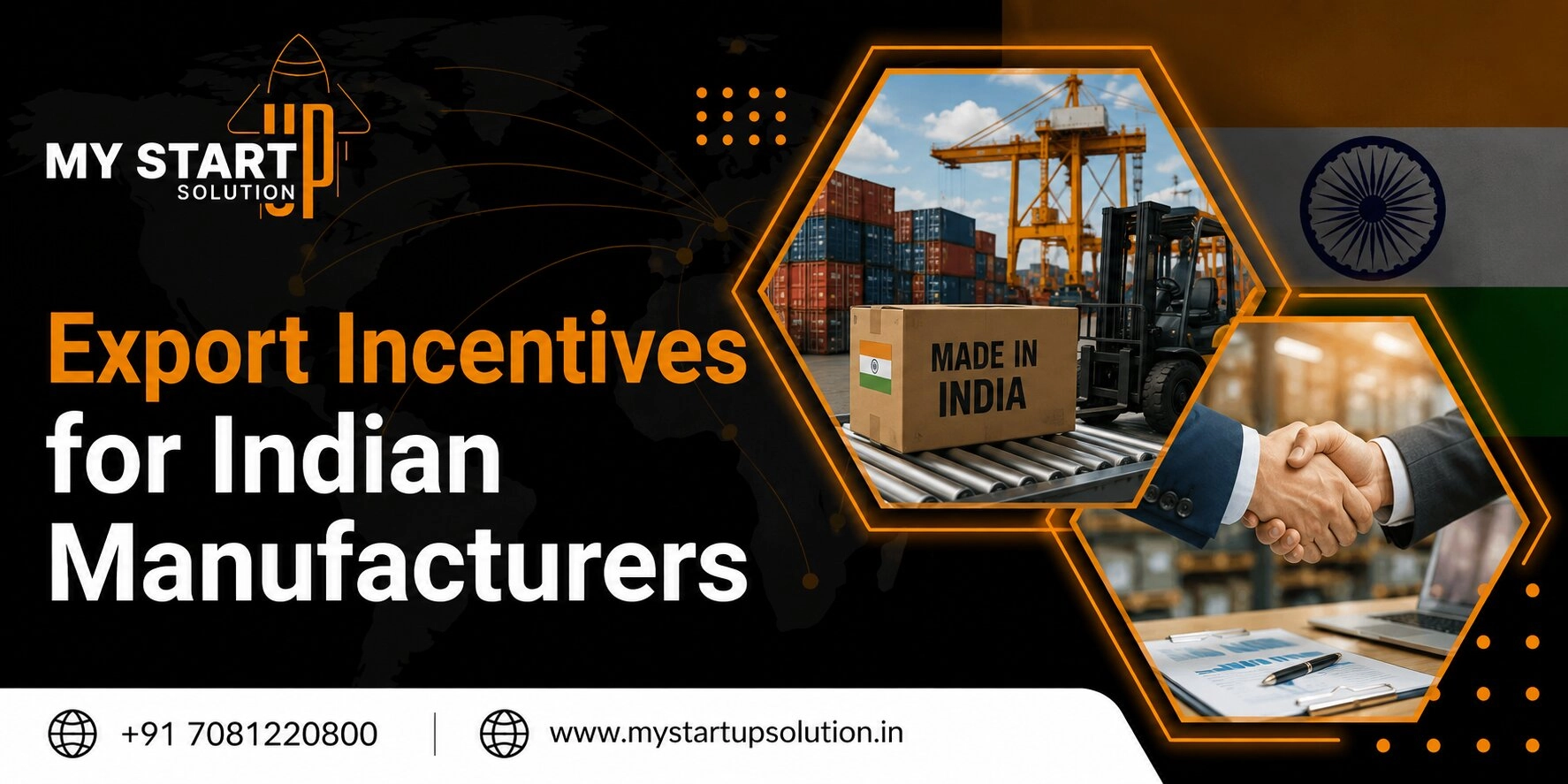
Export Incentives for Indian Manufacturers
Maximize global reach with My Startup Solution! Unlock essential export incentives for Indian manufacturers. Call +91-7081220800 for expert trade assistance.
Export Incentives for Indian Manufacturers: A Complete Guide by My Startup Solution
India is emerging as a prominent manufacturer for the global community. To fuel this development, the Indian Government offers various concessions to companies that market their products abroad. These are known as export incentives. Export Incentives for Indian manufacturers play an important role in helping you cut costs, ensure better cash flow, and make Indian products more competitive in foreign markets. Our experts at My Startup Solution provide you guidance in utilizing these programs in the best possible manner. This manual will help you learn about these export incentives, their importance and ways to reap the maximum from them.
What Are Export Incentives in Simple Words?
Export incentives are incentives offered by the government of India to firms engaged in exporting their products to other countries. The most important objective of these export incentives is to offer Indian products a competitive edge in international markets. Manufacturing firms have to bear huge costs in raw material procurement, taxes, and transportation.
Common forms of export incentives include:
- Refund of taxes and duties paid during production
- Duty-free import of machines or raw materials
- Low-interest loans for export orders
- Support for marketing in foreign countries
- Simple paperwork and faster approvals
These incentives push manufacturers to produce more, sell more, and grow their business across borders.
Why Export Incentives Matter for Manufacturers in India?
Manufacturing units in India spend a lot of money on inputs, power, and logistics before a product is ready for export. Without any kind of incentives, the foreign customers will view Indian goods to be expensive. Export incentives close this gap and help manufacturers price their products fairly in the world market.
These schemes help in the following ways:
- Lower the final cost of the product
- Free up working capital that was stuck in taxes
- Reduce the risk of doing business abroad
- Give manufacturers a fair chance against foreign competitors
This is why thousands of small and large manufacturers depend on these schemes every year to stay profitable.
Who Manages Export Incentive Schemes in India?
The various governmental institutions cooperate in operating the export incentive schemes for manufacturers. They have different roles that include policy making, refunds and so forth. It is therefore important to know who does what for the ease of application by manufacturers.
|
Authority |
Main Role |
|
DGFT (Directorate General of Foreign Trade) |
Runs most manufacturing export schemes and issues IEC codes |
|
CBIC (Central Board of Indirect Taxes and Customs) |
Manages customs duty, GST refunds, and duty drawback |
|
RBI (Reserve Bank of India) |
Controls financial and interest-related incentives |
|
Export Promotion Councils |
Guide manufacturers sector-wise and issue certificates |
|
Ministry of Commerce and Industry |
Sets overall export policy and new scheme rules |
Key Benefits of Export Incentives for Manufacturers
Export incentives are not just about saving tax. They bring wide benefits to the manufacturer, the workers, and the country as a whole.
Main benefits are:
- Lower production cost – Duty-free inputs and tax refunds cut the cost of making goods.
- Improved cash flow – Tax refunds and rebates free funds tied up in the form of taxes.
- More employment – Increased exports will require more people to work in the factory.
- Entry into new markets – Competent pricing allows entry into new foreign markets.
- Stronger foreign exchange reserve – Every export order brings in foreign currency for the country.
Manufacturers who use these benefits well can grow faster than those who ignore them.
Main Export Incentive Schemes for Indian Manufacturers
India offers several schemes specially suited to manufacturing companies. Each scheme covers a different cost or need, so manufacturers often use more than one at the same time.
1. RoDTEP (Rebate of Duties and Taxes on Exported Products)
The scheme provides refunds of indirect duties such as fuel tax, electricity duty and mandi tax, which fall outside the ambit of GST. It is beneficial for manufacturers to price their product better in foreign markets.
2. Duty Drawback Scheme
It offers manufacturers refunds of the customs duty levied on imports of raw materials to produce exports. It helps bring down input costs from the very beginning of production.
3. Advance Authorization Scheme (AAS)
The scheme allows duty-free imports of raw materials, fuels and packaging materials to manufacture exports, thus reducing manufacturing cost of the manufacturer.
4. EPCG (Export Promotion Capital Goods Scheme)
It offers duty free imports of machinery required for manufacturing exports provided they achieve a fixed amount of exports value.
5. GST Refund Options
Exporters have two options – one is to export goods under Letter of Undertaking and export without paying GST. Second option is payment of IGST first and then claiming refund from customs authority.
6. Interest Equalization Scheme (IES)
It provides interest subsidy on pre shipment/post shipment financing mainly to MSME manufacturers.
7. Export Oriented Units (EOU) Scheme
Factories which export all or majority of their production have benefits from this scheme. It is an incentive for producing in full scale and exporting their products to the international market.
8. Production Linked Incentive (PLI) Scheme
This provides cash benefits to manufactures in various sectors such as electronics, textiles and pharma, depending upon additional production and sales.
Also Read: How Foreign Companies Can Set Up a Liaison or Branch Office in India
Export Incentives vs Domestic Manufacturing Support
Manufacturers sometimes get confused between schemes made for exports and schemes made for local production. Both are useful, but their goals are different.
|
Point |
Export Incentives |
Domestic Manufacturing Support |
|
Purpose |
Boost sale of goods to other countries |
Boost sale of goods within India |
|
Focus |
International buyers |
Local buyers and industries |
|
Main gain |
Foreign currency and global reach |
Reduced import dependence |
|
Example scheme |
RoDTEP, Duty Drawback |
PLI for domestic sales, Make in India support |
Understanding this difference helps manufacturers pick the right scheme for the right goal.
Step-by-Step Guide to Apply for Export Incentive Schemes
Applying for export incentives is a simple process once you know the steps. Manufacturers do not need to feel confused by government paperwork if the process is followed in order.
Step 1: Select an Right Scheme
Ensure that you select the correct scheme for your product, industry, and exports.
Step 2: Collect Documents
Keep all the documents necessary for dispatching, IEC code, GST and accounting information.
Step 3: Submit Application
Submit your application to either DGFT or Export Promotion Councils.
Step 4: Track and Receive Benefit
After approval, the refund, rebate or duty exemption is credited to your account or license.
Also Read: Agriculture & Food Processing Subsidies in India
Best Practices for Manufacturers Using Export Incentives
Getting the most from export incentives needs a bit of planning and the right guidance. Many manufacturers lose money simply because they miss deadlines or apply for the wrong scheme.
Follow these best practices:
- Maintain export-import records accurate and error-free.
- File schemes shortly after shipment to save time on refund.
- Keep track of any policy changes since schemes such as RoDTEP rates keep changing.
- Take assistance from professionals in trading before starting business in new countries.
- Consider options like SEZ units along with rebates.
Good record keeping and timely filing are the biggest reasons some manufacturers get faster refunds than others.
How My Startup Solution Helps Manufacturers – Call +91-7081220800
Many manufacturers know that export incentives exist, but they struggle with paperwork, scheme selection, and follow-up with government departments. My Startup Solution was built to solve exactly this problem for Indian manufacturers.
Here is how we support you:
- We check your business and match you with the right export schemes
- We handle documentation for DGFT, customs, and GST refund claims
- We track your application status and follow up with authorities
- We keep you updated on new schemes and rate changes
- We offer one-on-one guidance for first-time exporters
If you are a manufacturer and want to claim your export incentives without stress, call My Startup Solution at +91-7081220800 and let our team guide you from start to finish.
Conclusion
Export incentives are one of the strongest tools available to Indian manufacturers today. From duty refunds to interest support and duty-free imports, these schemes are designed to lower cost and raise profit for businesses that sell abroad. Export Incentives for Indian Manufacturers are not hard to access once you know which scheme fits your business and how to apply correctly. The real challenge is not the lack of benefit, but the lack of guidance and timely paperwork. This is where working with a trusted partner makes a real difference. My Startup Solution is always available to assist any manufacturer through each scheme, form, and follow-up in the incentive process, so that they can concentrate on production and growth.