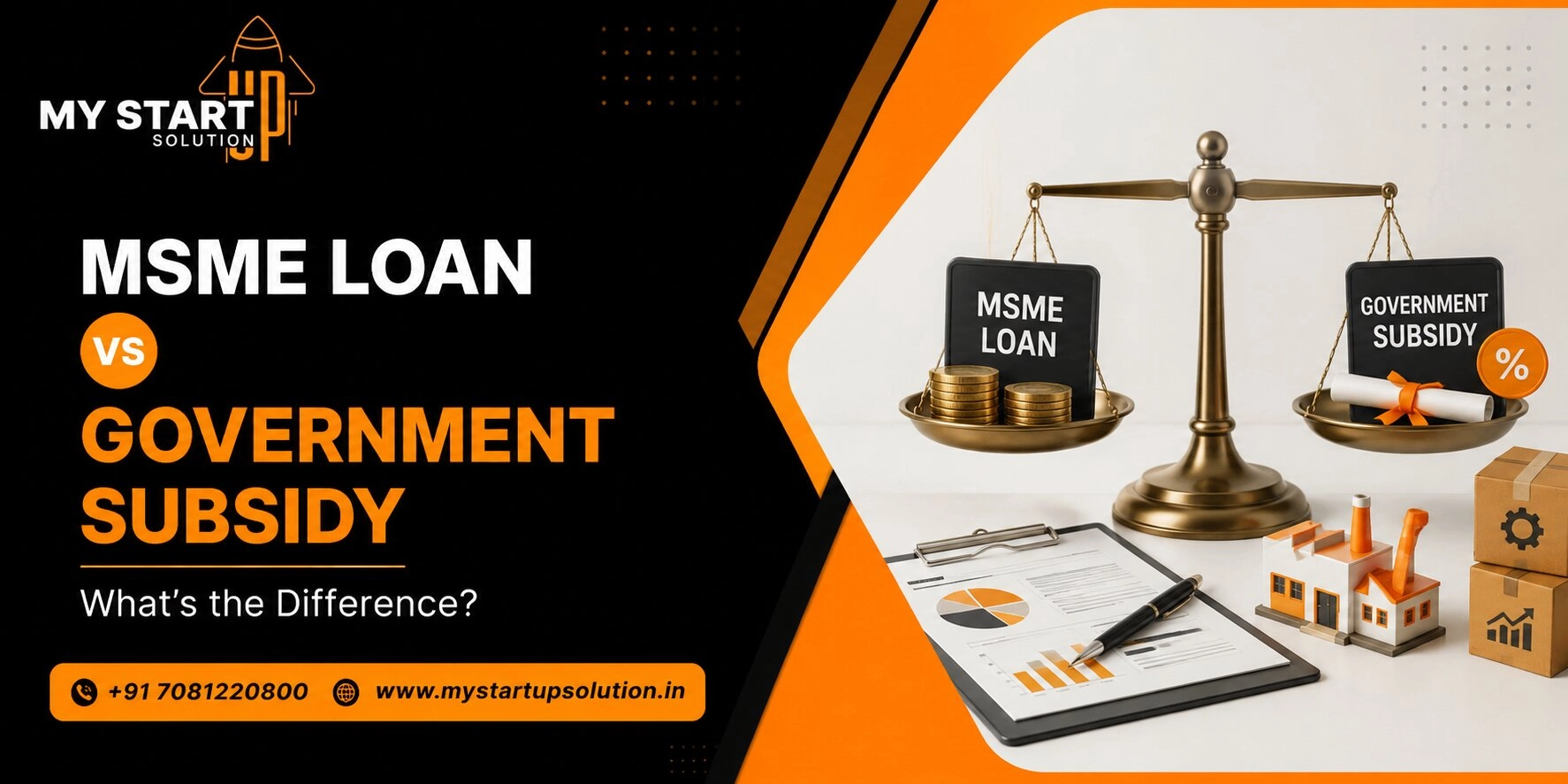
Expanding or starting a business may need additional funds. Most small business owners seek financial support but become confused between an MSME loan and a government subsidy. Though both have their own benefits for the growth of businesses, they vary in nature. Making the correct choice of either of these options can save your time and efforts and also help you make the best financial decision.
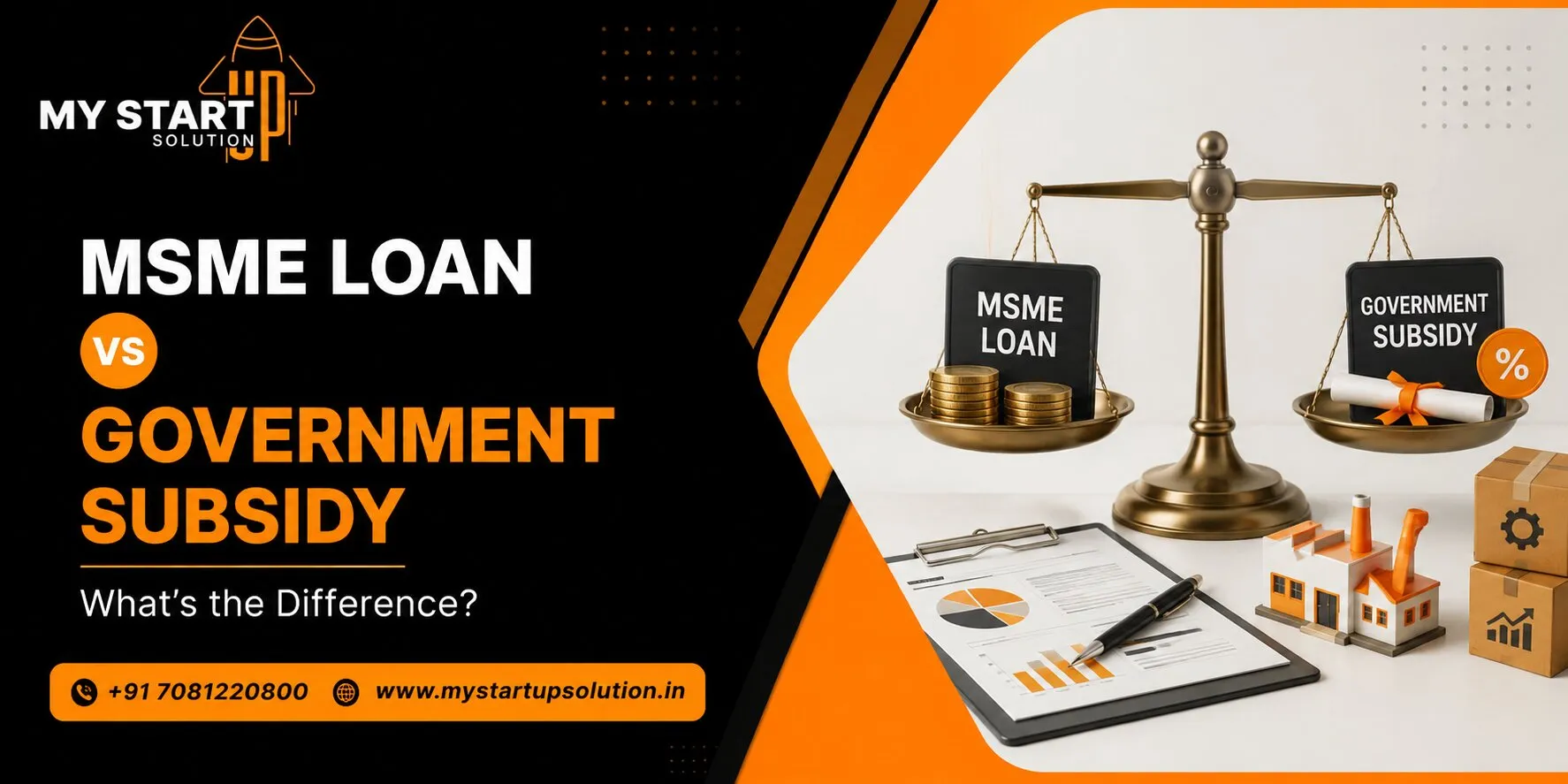
The majority of business owners in India utilize both the financial instruments for expanding the business, purchase of equipment, working capital requirements or even for establishing a new business unit. Despite being financial assistance, there is a big difference between these two methods. One is the money borrowed which needs to be paid back with interest, whereas the latter is not paid back under certain circumstances. My Startup solutions will help you to understand both the terms in a detailed manner in the article.
A business loan provided by banks, NBFCs, and other financial institutions to Micro, Small and Medium Enterprises (MSMEs) is known as an MSME loan. MSME loans help in managing everyday expenses, procurement of equipment, increasing stock or expanding business activities.
The loan amount varies according to the turnover of the business, credit record of the entrepreneur, repayment capacity of the borrower, and policies of the lender. The loan amount is paid back by the borrowers through regular monthly payments along with the interest for a specific period.
MSME loans are best suited for businesses which require immediate cash flow and have a proper plan regarding repayment. They offer a quick source of funding to the entrepreneurs without any hassles of getting government approval.
Government Subsidy is a type of financial support offered by the Central or State Government for fostering the growth of businesses in specific industries. Unlike loans, subsidies do not necessarily have to be returned, on condition that the recipient meets all conditions laid out in the scheme.
The types of subsidies offered by governments include partial payments for project costs, machinery, technology upgradation, training, exports, and business setup. Subsidies can be of the nature of financial aid as well as interest subsidies, capital subsidies, and reimbursements of eligible expenditures.
The first step towards obtaining subsidies includes fulfilling the requirements, submitting necessary documentation, and undergoing a verification process. Obtaining subsidies may take more time than taking out a business loan as it is subject to government procedures and schemes.
However, while both the methods offer financial help, they are meant for different purposes. This makes it important for entrepreneurs to understand these distinctions.
Here is the comparison between an MSME Loan and a Government Subsidy organized in a table :
|
Feature |
MSME Loan |
Government Subsidy |
|
Repayment |
Must be repaid with interest |
Usually not repayable if conditions are met |
|
Source |
Banks, NBFCs, Financial Institutions |
Central or State Government |
|
Processing Time |
Usually faster |
May take longer |
|
Interest |
Interest is applicable |
No interest on subsidy amount |
|
Purpose |
Working capital, expansion, machinery, business needs |
Specific government-approved projects or activities |
|
Eligibility |
Based on lender assessment |
Based on scheme guidelines |
|
Flexibility |
Can be used for approved business purposes |
Limited to scheme objectives |
The following are some of the advantages that come with MSME loans. Firstly, the most obvious advantage is the quick access to finances. The processing of eligible loan applications is very quick. Secondly, one can choose a repayment period depending on his or her financial ability. Thirdly, the flexibility of loan amounts, tenures, and institutions makes these types of loans applicable to businesses at various stages.
Another major advantage that comes with MSME loans is the fact that they help build good business credit history through repayment of the loan.
A loan for an MSME is a loan that is given to companies requiring funds for working capital, expansion, purchase of machinery, or other business purposes. Loans are offered to eligible businesses by banks and financial institutions on the basis of the company’s financial standing and the relevant documentation.
The kinds of businesses which can generally apply for the loan are:
The applicant needs to provide proof of business registration, identity and address proof, bank statement, financial statements, and other documents required by the lender.
Government subsidies reduce the financial burden on entrepreneurs by lowering project costs. Since the subsidy amount generally does not require repayment, businesses can invest more confidently in expansion, manufacturing, technology, or employment generation.
Most subsidy programs also promote innovations, rural business activity, women business ventures, start-ups, exports, and manufacturing through different government programs. Companies that fit the eligibility criteria have the ability to greatly lower their cost of capitalization, while enhancing profitability.
Government Subsidy schemes are implemented by the government for business development, job creation, production, export, and entrepreneurship. The eligibility depends on the purpose of the subsidy scheme and conditions specified by the Central or State Government.
Applicants may be:
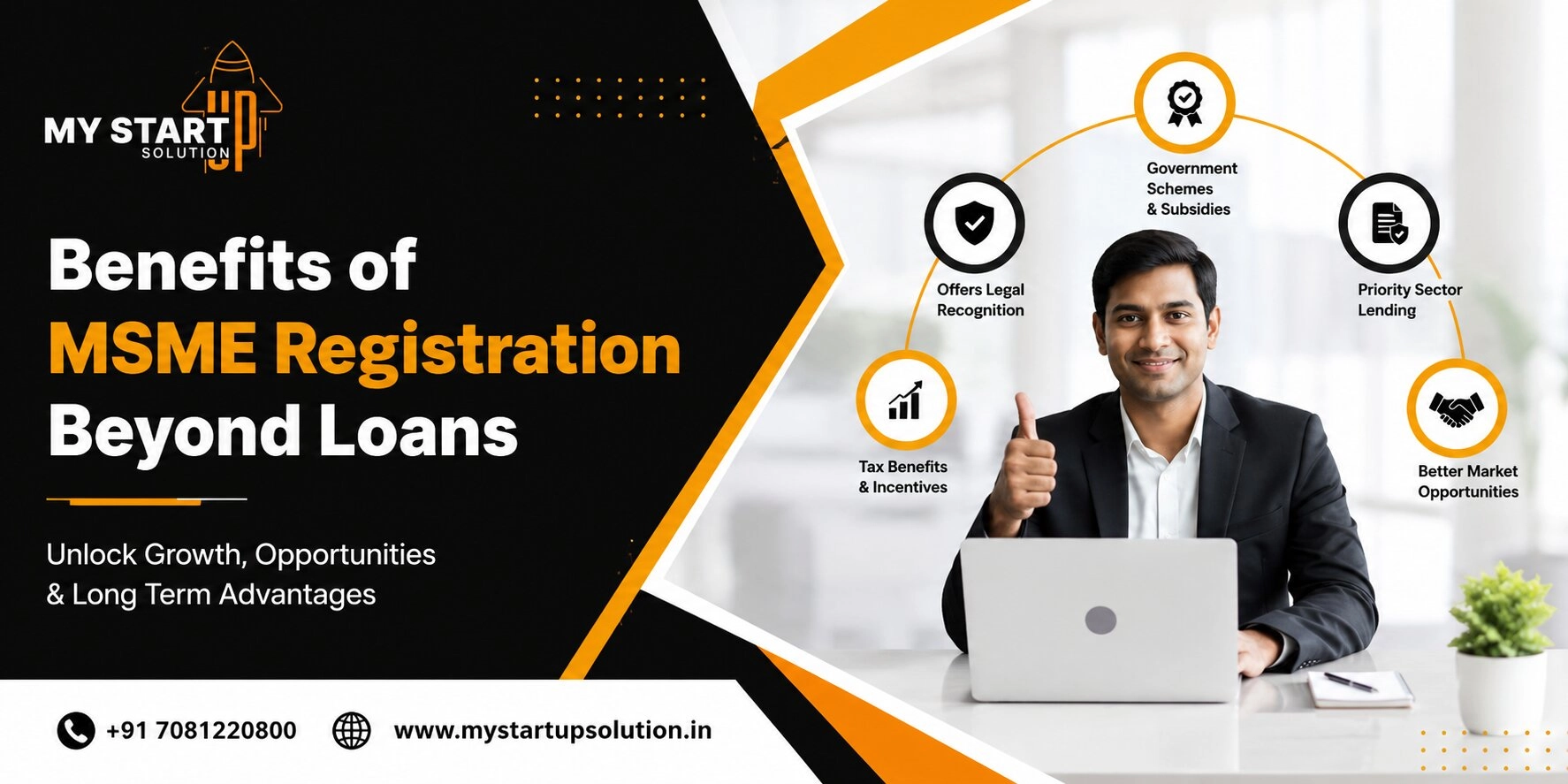
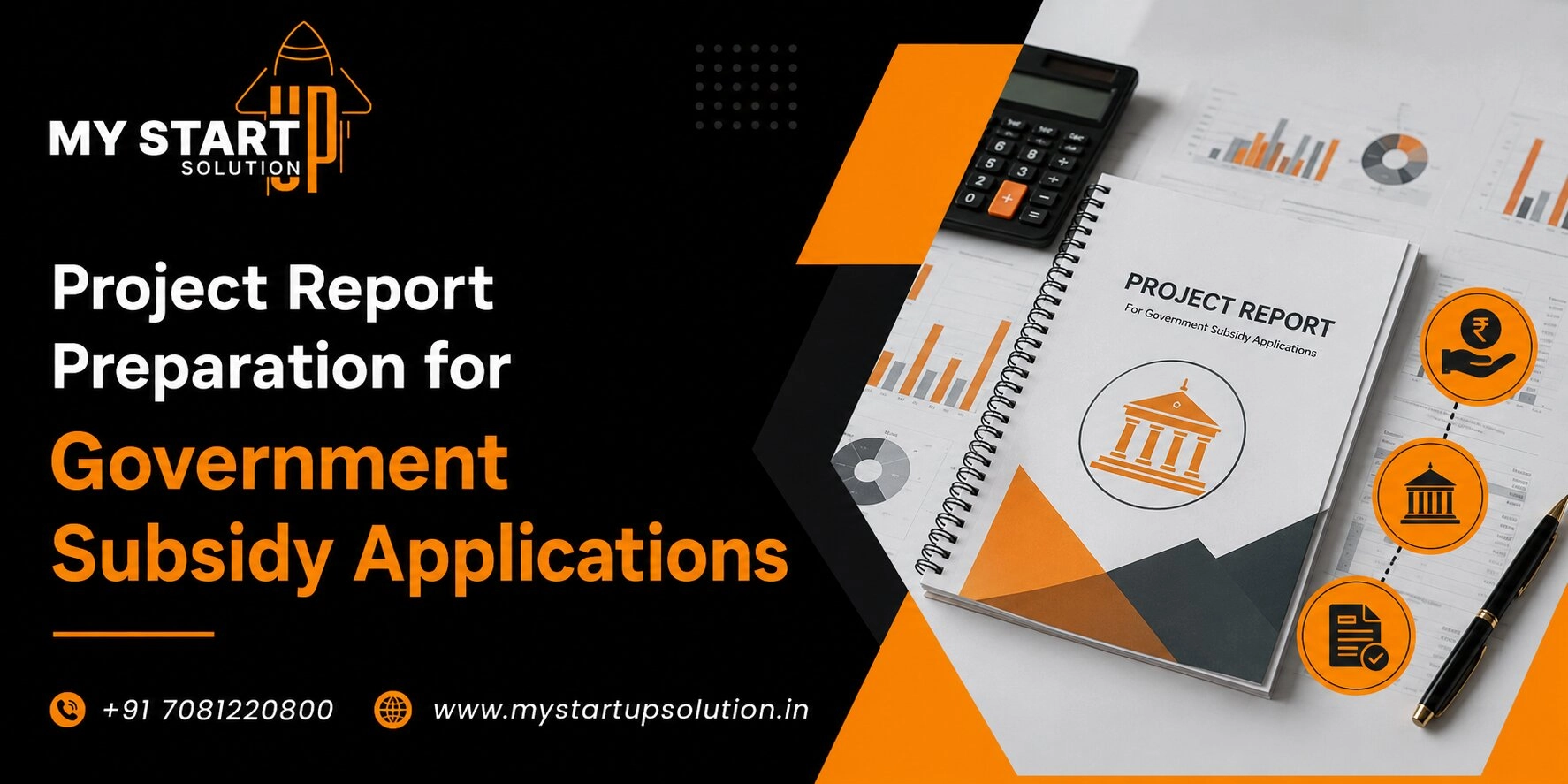
Normally, all subsidy schemes have certain eligibility criteria, submission of required documents, and a proper application procedure. Possession of Udyam Registration, proper project report, and adherence to government guidelines may help get financial assistance.
What is needed totally depends on the nature of your business. In cases where your business requires urgent working capital or expansion money, the most practical route would be to go for an MSME loan. The money will come instantly without requiring many processes and thus you will be able to do business.
In cases where your business falls under a government program and your project meets the goals of the subsidy, then you will be able to benefit from the subsidy. Some businesses actually take up both methods at once. They use an MSME loan to finance their projects and get subsidies.
This way, careful planning ensures the selection of a good funding source which does not add to any unnecessary financial pressure.
Whether applying for an MSME loan or a government subsidy, keeping documents ready improves the approval process. Although requirements vary, businesses commonly need :
Some subsidy schemes may require additional documents depending on the nature of the project.
Many entrepreneurs make their application without verifying their eligibility, which causes many delays or outright rejections. Having knowledge about the scheme or the loan before making the application is a good idea to save time.
Incompleteness in documents is yet another reason that causes delay in the application process. It is important not to apply for higher amounts of the loan as it will impact the business’s cash flow negatively. Reading the complete terms and conditions of loans and subsidy schemes helps to avoid any confusion in the future.
Professional help is available for identifying the right scheme for the business.
It can be quite difficult to find the best financing source. Each and every company has its own needs in terms of finances. Choosing the most appropriate MSME loans and government subsidy schemes will definitely require some proper planning. We at My Startup Solutions are here to assist the entrepreneurs to choose the best financing sources through our expert advice and also help them with the entire application procedure.
Our experts review your business profile and requirements and also suggest some most appropriate MSME loans or subsidy options for your firm.
We can assist you with :
Be it launching a new firm, expansion of an existing one, purchase of machinery or improving the efficiency of working capital, My Startup Solutions provides all the help you need to pass through the procedure successfully. Our motto is to make business financing hassle-free so that you can focus on developing your business and we do the paperwork for you.
In case you need assistance with your MSME loan, government subsidy scheme or even selecting a funding option that would be best suited for your company, we have got your back. We provide you with the guidance required regarding the procedure, documentation, eligibility, and even filing of the application to make everything easy for you. No matter whether you are running an established company or even setting up a new one, we will help you find the best financial assistance for your company according to its requirements. If you need further assistance, feel free to call us at +91-7081220800.
An MSME loan must be repaid with interest, while a government subsidy provides financial support that usually does not require repayment if all eligibility conditions are successfully fulfilled.
Micro, Small, and Medium Enterprises with valid business documents, satisfactory credit history, repayment capacity, and lender eligibility can apply for an MSME loan in India successfully.
Eligible startups, MSMEs, manufacturers, service businesses, women entrepreneurs, and businesses meeting specific government scheme conditions can apply after submitting required documents and approvals successfully.
Common documents include Aadhaar, PAN, Udyam Registration, GST details, bank statements, income tax returns, financial statements, address proof, and business registration certificates for verification purposes.
Required documents generally include business registration, Aadhaar, PAN, project report, bank details, financial records, Udyam certificate, and additional documents specified under the selected government subsidy scheme.
Yes, several government schemes support new businesses and startups. Eligibility depends on business type, investment amount, industry, location, and compliance with scheme guidelines and documentation requirements.
Yes, many banks and financial institutions offer collateral-free MSME loans under eligible government-backed guarantee schemes, depending on business profile, repayment capacity, and lender approval policies and terms.
Loan approval time varies by lender, documentation, and eligibility. Many financial institutions process eligible MSME loan applications within a few working days after successful document verification and assessment.
Government subsidy approvals usually take longer because applications undergo departmental verification, inspections, document reviews, and approval processes according to the selected scheme's official guidelines and procedures.
Yes, MSME loans can be used to purchase machinery, equipment, raw materials, inventory, working capital, business expansion, and other approved business-related financial requirements based on lender terms.
Various Central and State Government schemes provide subsidies for manufacturing, technology upgrades, exports, women entrepreneurs, startups, and business expansion based on eligibility and project requirements successfully.
My Startup Solutions assists businesses with MSME registration, documentation, project reports, subsidy guidance, loan applications, compliance support, and selecting suitable funding options based on business eligibility.
You can contact My Startup Solutions at +91-7081220800 for expert guidance on MSME loans, government subsidy schemes, documentation, registrations, and business funding support across India.
The better option depends on your business needs. Loans provide quick funds, while subsidies reduce project costs. Many businesses benefit by using both together for growth.
Yes, eligible businesses can avail both benefits under certain schemes. The subsidy may reduce project costs or interest, while the MSME loan covers remaining funding requirements.





"Choosing 'My Startup Solution' for my startup's accounting needs was one of the best decisions I made. The team's dedication to accuracy and their personalized approach to my financial situation set them apart. They go above and beyond to ensure I'm well-informed and compliant, allowing me to focus on my business's growth."

"The team at 'My Startup Solution' has been a true partner in my entrepreneurial journey. Their insightful financial guidance and meticulous attention to detail have helped me navigate complex financial matters seamlessly. With their support, I can confidently steer my startup toward success, knowing that my financial matters are in capable hands."