Respond to GST Notice ASMT 10 for GSTR Differences
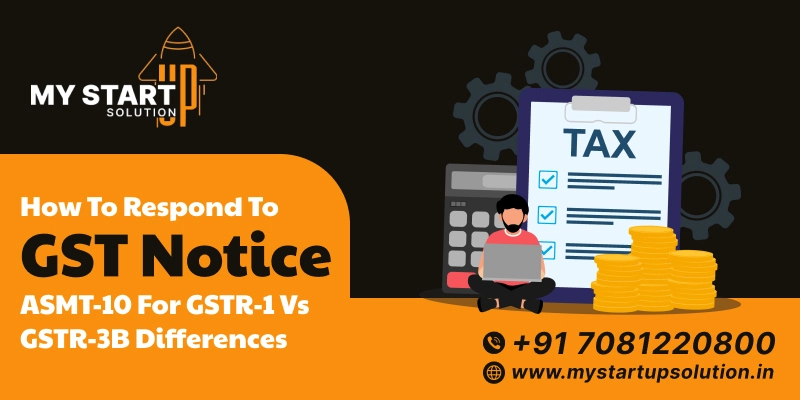
Received a GST Notice ASMT-10 for GSTR-1 vs 3B differences? Don't panic. Learn how to respond correctly. For expert assistance, call My Startup Solution at +91-7081220800.
How to Respond to GST Notice ASMT-10 for GSTR-1 vs GSTR-3B Differences – My Startup Solution
Businesses registered under GST often receive notices when the sales declared in GSTR-1 do not match the tax liability reported in GSTR-3B. One of the more common notices from the GST department is ASMT-10, which is basically issued for return scrutiny where the taxpayer is asked to explain the gaps or differences that appear in their filings. Knowing how to Respond to GST Notice ASMT-10 for GSTR-1 vs GSTR-3B Differences properly can help a business steer clear of penalties, interest, and even ongoing legal trouble later on. You should take action on time, do proper reconciliation, and keep the supporting paperwork in place while drafting the reply. With professional help from My Startup Solution, the whole response process can feel easier and also move faster.
Understanding Form GST ASMT-10 and Mismatches
The tax department issues Form GST ASMT-10 under Section 61 of the Central Goods and Services Tax Act. This form works as an official communication about mismatches that show up during automated data scrutiny, sorta like an early heads up. The government then compares your sales records across various tax forms and if your reported sales figures do not match what you actually paid in taxes the system flags your profile for evaluation. It also points to particular tax gaps , interest amounts and those sudden financial variations that look unusual. Treating this document as a first signal can help you fix the issue before the tax department begins stronger recovery actions.
Main Reasons for Receiving ASMT-10 Notice
Many businesses get ASMT-10 notices simply because of minor filing errors. Even very small mistakes can cause a GST investigation.
Common reasons are:
- Sales shown higher in GSTR-1
- Tax liability shown lower in GSTR-3B
- Wrong GST rate applied
- Duplicate invoices uploaded
- Credit notes not adjusted
- Amendments filed incorrectly
- B2B and B2C invoices mixed up
- Data entry mistakes
Proper filing of returns lowers the risk of receiving such notices.
Time Limit to Reply to GST ASMT-10 Notice
GST law gives a small time for clarifications after the notice has been served. The time given to the taxpayer to respond is generally 30 days.
Delays may create additional problems like:
- Demand notices
- Penalty proceedings
- Interest liability
- GST audit risk
- Cancellation related issues
Taking action in time will help enterprises to avoid unnecessary legal trouble.
Documents Required for ASMT-10 Reply
Accurate documents are the major part of a response preparation set up.
Keep these documents ready:
- Copy of ASMT-10 notice
- GSTR-1 returns
- GSTR-3B returns
- Sales register
- Tax invoices
- Reconciliation statement
- Debit and credit notes
- E-way bills if required
- Working papers for calculation
Supporting documentation adds weight to the response submitted to the department.
Step by Step Process to Respond to GST Notice ASMT-10
Companies may have a process that they use as guidance to prepare the response in a proper way.
Step 1: Review the Notice Carefully
Kindly verify the tax period and the mismatch amount that indicated in this notice.
Step 2: Compare Returns
Now match the GSTR-1 with GSTR-3B and check the exact reason for the mismatch.
Step 3: Prepare Reconciliation
Write a reconciliation statement that explains categorically any difference.
Step 4: Collect Supporting Documents
Add invoices, returns and any other related documentation.
Step 5: Draft Proper Reply
Explain professionally and use simple words.
Step 6: Submit Online
Send your response by the GST portal within the allowed time only.
Online Process to Submit ASMT-10 Reply on GST Portal
On the GST portal, taxpayers can easily submit their explanations and clarifications online.
Basic process:
- Login to GST portal
- Open Services section
- Select User Services
- Open View Additional Notices
- Select ASMT-10 notice
- Upload reply and documents
- Submit using DSC or EVC
Please keep the acknowledgement in a secure place for your future reference.
Format of Reply for GST ASMT-10 Notice
A proper reply should be simple and fact finding based, with all the information supported by some documents.
Basic structure includes:
- Reference to notice number
- GSTIN details
- Explanation of mismatch
- Reason for difference
- Supporting calculations
- Document attachment list
- Request for acceptance
Proper drafting gives a good first impression before the GST officer.
Common Mistakes to Avoid While Replying to ASMT-10
Most of the taxpayers have trouble while replying to the GST notice. Wrong replies will get rejected by the department.
Avoid these mistakes:
- Ignoring the notice
- Submitting incomplete reply
- Wrong reconciliation
- Missing supporting documents
- Incorrect tax calculations
- Delayed response
- Copy-paste explanations without proof
Professional review enhances the quality of the response.
How My Startup Solution Helps in GST ASMT-10 Reply
My Startup Solution offers expert support for GST notice response and reply writing. Proper expert guidance can help prevent other tax problems occurring in the future.
Services include:
- GST notice analysis
- Reconciliation preparation
- Reply drafting
- GST portal submission support
- Tax calculation verification
- Legal guidance for GST scrutiny
For any help required for GST ASMT-10 notices and GST return filing, then contact My Startup Solution at +91-7081220800.
Conclusion
GST Notice ASMT-10 for GSTR 1 vs GSTR-3b disparities is a generally common GST department ASMT-10 scrutiny notice. Correct awareness of the discrepancy, response filing and notification reconciliation is essential for avoiding later notice penalties and GST legal issues. Correct filing of the excess registration return through proper account and reconciliation checks can reduce the notice risks. Sometimes, adequate professional aid can make the notice process stress free. My Startup Solution helps the business to prepare professional GST notice responses, reconciliation statements and compliance solutions.