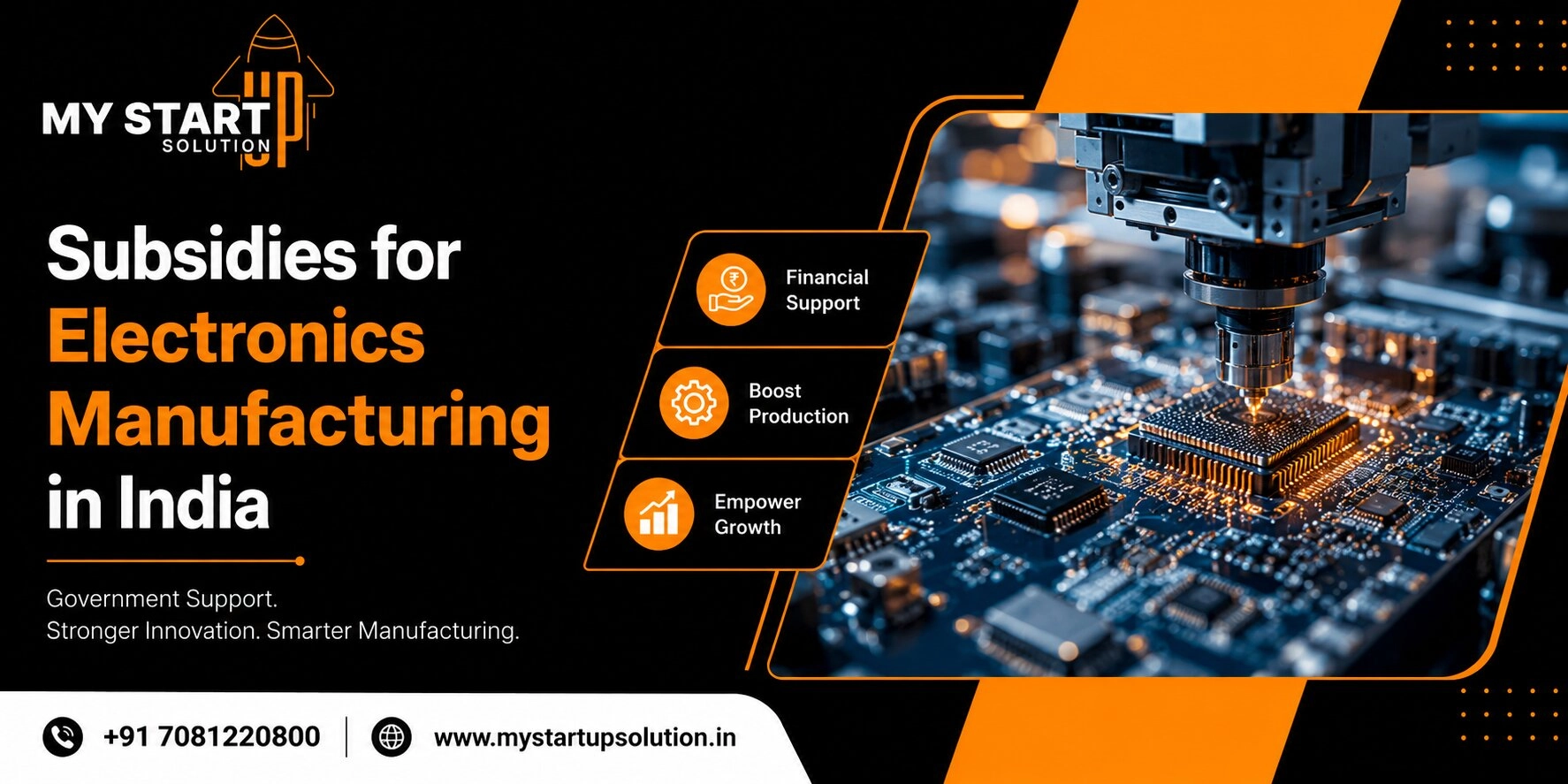
Subsidies for Electronics Manufacturing in India
Unlock growth with electronics manufacturing subsidies in India. Explore top schemes & incentives for your business. Call My Startup Solution at +91-7081220800.
Subsidies for Electronics Manufacturing in India – A Complete Guide by My Startup Solution
The sector of electronics manufacturing is rapidly growing in India due to high demands for mobiles, electronics, electrical, medical and other related products. The Indian Government is promoting the development of manufacturing activities in the country with monetary assistance in the form of various schemes. Subsidies for Electronics Manufacturing in India enable the firms to minimize their investment expenses, increase their manufacturing capabilities and compete not only in local but also in foreign markets. My Startup Solution assists businesses in understanding different subsidy schemes, filling out the required documentation and submitting their applications properly in order to use government benefits efficiently.
What is the Electronics Manufacturing Scheme?
The Electronics Manufacturing Scheme (ECMS) is an industrial scheme that was developed by the government of India for improving production of electronics and minimizing dependency on the international market. Under the ECMS, the government assists financially through construction of factories, expanding production capacities, purchasing machinery and adopting technologies. Other benefits include investments, innovation, employment creation and exports. The goal of this plan is to establish a robust environment for manufacturing electronics and fostering industrial development in the future, as well as transforming India into a global manufacturing power in electronics.
Why Government Subsidies are Important for Manufacturing Industries?
Government subsidies have an important role in facilitating the manufacturing sector because they ease the burden of finance for firms. The manufacturing industry demands substantial investments in land, machines, equipment, technology, research and trained labor. Government subsidies create confidence in firms to invest and thus help them increase their productive capacity. Moreover, these subsidies help firms produce better quality products and improve their competitive position in the domestic and international market. Through these subsidies, firms adopt new technologies, create jobs and help the country grow economically.
Eligibility Criteria for Electronics Manufacturing Subsidies
There is a variation in the requirements of various subsidy schemes offered by the government. It is advisable for business to read the requirements before application for approval.
- The applicant must be a legal business firm in India.
- The manufacturing operation must belong to the electronics or electronic components category.
- The project should fulfill the minimum investment threshold of the scheme.
- The company must follow the laws related to GST, income tax, etc.
- The company should have proper bookkeeping and audited accounts.
- All the necessary approvals and certifications should be present.
- The project should fulfill the conditions related to employment/production if any.
- The applicant should provide complete information while applying for the scheme.
Ensuring that the eligibility requirements are met before the submission of the application will help to prevent any problems related to the rejection of the application and will enable quick handling of the subsidy claims by the government.
Documents Required to Apply for Electronics Manufacturing
Documentation is considered one of the essential steps in the subsidy application process. It makes sure that there will be no delays in the process and improves the possibility of being approved.
- Company registration certificate and PAN card
- GST registration number and tax filing proof
- Detailed project report with cost and production plan
- Land or factory ownership or rent papers
- Bank account details and financial statements
- Machinery and equipment purchase bills or quotations
- Import Export Code, if the company deals in international trade
A smooth submission of the documents that have been duly verified reduces chances of any query from government authorities.
Step-by-Step Process to Apply for Government Subsidies
Electronics manufacturers should plan properly and follow government guidelines while making their applications for a subsidy. Proper implementation of the process increases chances of financial assistance without any hassle.
- Check the eligibility rules of the chosen scheme carefully
- Collect all required documents and papers in advance
- Fill the online application form on the official government portal
- Upload the project report and supporting documents correctly
- Submit the form and note down the application number
- Wait for the review and respond to any query from officials
- Receive approval letter and start claiming the subsidy amount
The systematic process of applying for subsidies along with proper documentation can ensure that businesses obtain subsidies from the government without any delay.
Government Subsidy Schemes for Electronics Manufacturing Industries in India
There are a number of schemes in India which provide assistance in electronics manufacturing. These schemes target different segments of the industry. Information about all these schemes is essential for companies in selecting the most suitable one.
- Electronics Components Manufacturing Scheme (ECMS) for Parts and Sub-Assemblies: ECMS assists the production of electronics components, parts, and sub-assemblies by offering fiscal incentives to ensure greater production locally and enhance the electronics industry chain in India.
- Production Linked Incentive (PLI) Scheme for Large-Scale Electronics Makers: PLI Scheme makes provisions for incremental incentives which encourage the growth in manufacturing of electronics and creation of job opportunities for people.
- Scheme for Promotion of Manufacturing of Electronic Components and Semiconductors (SPECS): SPECS offers financial support in capital investment in the production of electronic components and semiconductors to make firms cut down their cost and beat other firms.
- Modified Electronics Manufacturing Clusters (EMC 2.0) for Shared Factory Spaces: EMC 2.0 is a good starting point to help develop world-class manufacturing clusters through facility sharing. It makes life easy for electronics manufacturers.
- Semiconductor Mission for Chip and Semiconductor Production Support: The Semiconductor Mission aims at manufacturing semiconductors and chips in the nation through funding, building infrastructure, and developing technology partnerships.
- National Policy on Electronics 2019 for Overall Industry Growth Support: The National Electronics Policy 2019 is intended to establish India as a global electronics manufacturing destination through investments, innovation, exports, skill development and job creation.
Choosing the right government scheme will help to maximize profits as well as comply with all the government laws and regulations.
Benefits of Government Subsidies for Electronics Manufacturing Industries
Government subsidies assist electronics manufacturing industries in growing their businesses with reduced risks. They also assist in fostering innovation and improving the manufacturing ability of India.
- Lower starting cost for setting up a new factory or unit
- More money saved on machines and raw material purchase
- Higher chance to compete with big international electronics brands
- Support in creating more jobs for local workers
- Encouragement to use modern technology and better quality methods
- Easier access to funds for research and product development
- Growth in exports due to better and cheaper production
By utilizing the government subsidies appropriately, companies can benefit from their functioning, increase their profitability and help India in achieving its goal of becoming an electronics manufacturing destination.
Common Mistakes to Avoid While Applying for Electronics Manufacturing Subsidies
These are some of the common mistakes that should be avoided in order to increase the likelihood of approval and enable businesses to obtain government support without any hassles.
- Submitting incomplete or wrong documents in the application
- Not checking the eligibility criteria properly before applying
- Giving wrong financial numbers in the project report
- Missing important deadlines set by the scheme
- Applying without proper business registration or licenses
- Not following up with officials after submitting the form
- Ignoring expert advice and applying without proper guidance
Most of the applications are delayed or even rejected due to minor errors. Careful consideration while filling in the application form saves one time, effort and money.
Why Choose My Startup Solution for Electronics Manufacturing Consultant?
Application for subsidies requires a thorough understanding of the procedures involved along with proper documentation. My Startup Solution provides consultancy services for successful completion of the process.
- Team of experts having expertise in all types of electronic manufacturing plans
- Assistance in writing project reports and documents
- Advice on eligibility check prior to initiating application process
- Assistance in applying online without any difficulty
- Frequent follow-ups with government departments for speedy approvals
- Affordable consultation services for start-ups and growing companies
With My Startup Solution, you can save yourself from all those unnecessary paperwork and ensure that there are no mistakes in your applications. If you require any professional assistance, call us at +91-7081220800.
Conclusion
Electronics Manufacturing is proving to be one of the fast emerging sectors in India owing to government support and high demand in the market. Different subsidy schemes are used by the manufacturers to save on investment costs, upgrade technology, enhance production facilities, and grow the business with more confidence. The selection of an appropriate subsidy scheme and the proper application process play an important role in getting financial assistance. With professional assistance, the manufacturers will be able to get maximum benefit from the government subsidies and establish themselves successfully in the electronics manufacturing sector in India.